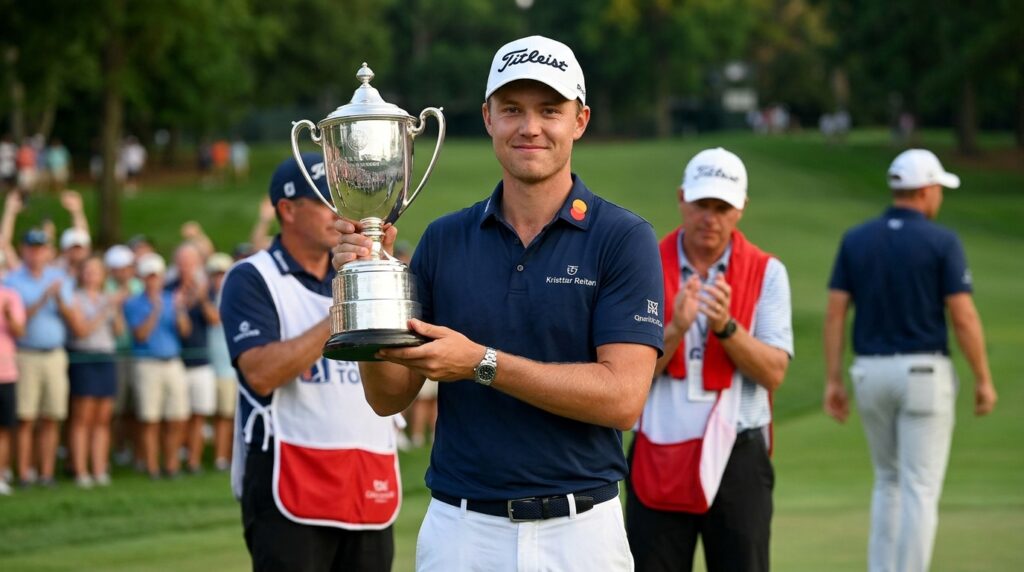
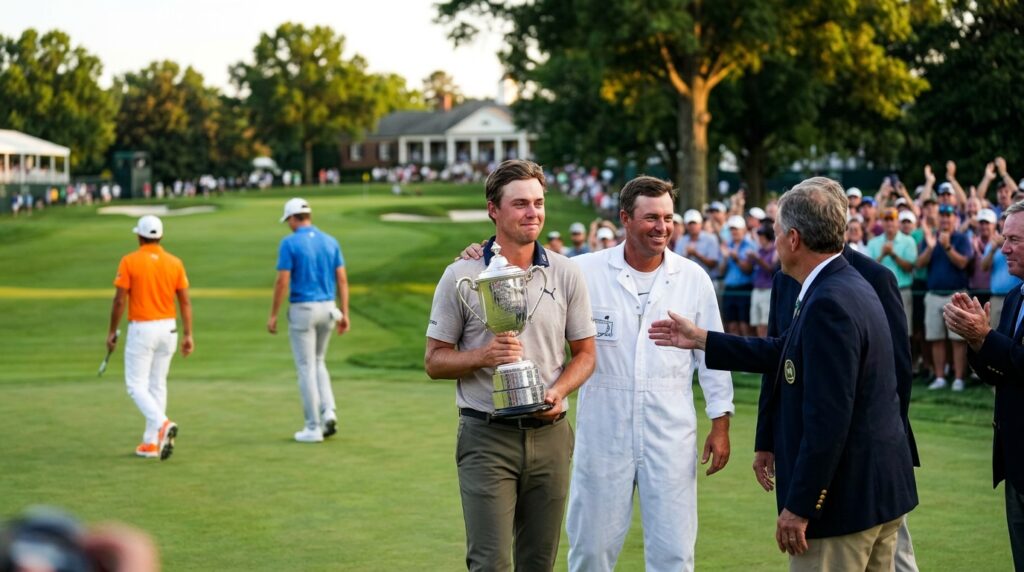
The Norwegian rookie closed with a composed 69 to win the Truist Championship by two strokes over Rickie Fowler and Nicolai Højgaard, turning a late charge into the defining victory of his career.
CHARLOTTE, N.C. — Kristoffer Reitan arrived at Quail Hollow still trying to prove that his rise from Europe to the PGA Tour could translate into a victory on one of golf’s biggest stages. By Sunday evening, the 28-year-old Norwegian had done far more than validate his place in the field. He had won the Truist Championship, held off a resurgent Rickie Fowler and Nicolai Højgaard, and secured the first PGA Tour title of a career that has already taken several sharp turns.
Reitan closed with a 2-under-par 69 at Quail Hollow Club to finish at 15-under 269, two shots clear of Fowler and Højgaard. The victory came in a high-profile PGA Tour event on one of the most demanding courses in American golf, where the final stretch can expose even experienced contenders. Reitan did not overpower the course in the final round. He outlasted it, choosing patience over panic and precision over spectacle.
His decisive move came after a tense opening to the back nine. Reitan began the day one shot behind 54-hole leader Alex Fitzpatrick and was even par for the round after 13 holes. Fowler, who started seven shots off the lead, surged into contention with a 30 on the front nine and briefly shifted the pressure onto everyone ahead of him. Reitan answered at the reachable par-4 14th and the par-5 15th, making back-to-back birdies that pushed him in front and gave him enough separation to survive the closing holes.
The finish was not simply a matter of protecting a lead. Quail Hollow’s closing sequence, long known as one of the sternest tests on the PGA Tour, requires a player to control distance, trajectory and emotion at the same time. Reitan reached the 18th knowing that a clean finish would be enough. His approach left him safely on the green, and a two-putt par completed a victory that was measured, efficient and quietly dramatic.
For Reitan, the win is the most significant moment yet in a career that has not always followed a straight line. He had won twice previously on the DP World Tour, but a PGA Tour victory carries a different weight. It brings status, security and a place in the conversation among players capable of winning against deeper fields and under greater scrutiny. It also earned him a place in next year’s Masters, adding an immediate major-championship reward to an already life-changing week.
The emotional force of the victory came from what preceded it. Reitan turned professional in 2018 and experienced the familiar turbulence of a player trying to turn promise into stability. There were moments when his career appeared to be moving sideways rather than forward. He has spoken in the past about periods when golf felt heavy, when the professional grind threatened to drain the purpose from the game. The player who lifted the trophy at Quail Hollow looked like someone who had come through that uncertainty with a clearer sense of who he was.
His final-round performance reflected that maturity. Reitan did not play as though he was trying to win with one spectacular shot. He kept the ball in play, accepted pars when the course demanded caution and waited for the right holes to attack. The birdies at 14 and 15 were important not only because they changed the leaderboard, but because they showed a player recognizing the right moment and executing under pressure.
Fowler’s charge gave the tournament much of its electricity. The American has long been one of the most popular players in golf, and his Sunday surge briefly suggested the possibility of a dramatic comeback victory. His front-nine 30 turned him from outsider into threat and forced the leaders to respond. Fowler eventually closed with a 65, a round that would have won many tournaments, but it was not enough to catch Reitan once the Norwegian steadied himself late.
Højgaard also left Charlotte with reason to believe his own breakthrough is close. The Danish player has the power and ball-striking to contend on major-championship-style courses, and his runner-up finish reinforced his standing among Europe’s most promising players. Yet Sunday belonged to Reitan, who matched Højgaard’s ambition with cleaner timing and a more decisive finish.
Fitzpatrick, the third-round leader, faded with a 73 and finished three shots back. His final round was a reminder of how quickly Quail Hollow can turn a small lead into a chase. The course rewards aggressive driving and precise iron play, but it rarely allows a player to coast. A single loose swing can change the shape of a tournament, especially when contenders are pressing from behind.
Reitan’s victory also fits into a broader moment for European golf. A new group of European players has been pushing deeper into PGA Tour fields, bringing experience from the DP World Tour and testing themselves more regularly against American-based competition. Reitan’s win shows that pathway can produce not just access, but success. He did not arrive as the week’s obvious favorite, but he left as a PGA Tour champion.
For Norwegian golf, the victory adds another important name to a growing international presence. Viktor Hovland has carried much of Norway’s modern profile in the men’s game, but Reitan’s title shows that the country’s impact is no longer limited to one star. His win will not instantly reshape the sport in Norway, but it gives young golfers there another example of what is possible.
The victory also changes Reitan’s professional schedule. A PGA Tour title brings opportunities that can alter a player’s season and career planning. Entry into major events, elevated confidence, improved status and greater attention from sponsors all follow. The challenge now is to turn one week into a foundation rather than a peak.
That will not be simple. Golf is full of first-time winners who discover that success creates new pressure. Opponents study them more closely. Expectations rise. Media attention expands. The weeks after a breakthrough often reveal whether a player can absorb the change without losing the habits that produced the victory in the first place.
Reitan’s game, however, appears built on qualities that travel well: solid driving, controlled aggression and a willingness to remain patient when the round becomes uncomfortable. At Quail Hollow, those traits mattered more than reputation. He defeated players with more PGA Tour history by staying more composed at the decisive moment.
The Truist Championship may be remembered for Fowler’s charge, Højgaard’s continued rise and Fitzpatrick’s missed opportunity. But the lasting image will be Reitan standing with the trophy after navigating one of the PGA Tour’s most respected venues. It was the kind of victory that can redefine how a player is viewed by peers, fans and perhaps most importantly by himself.
By the end of Sunday, Reitan was no longer just a promising Norwegian rookie with European wins and potential. He was a PGA Tour champion, a Masters qualifier and the author of one of the most important breakthroughs of the season. At Quail Hollow, he did not merely win a tournament. He crossed a threshold.”””