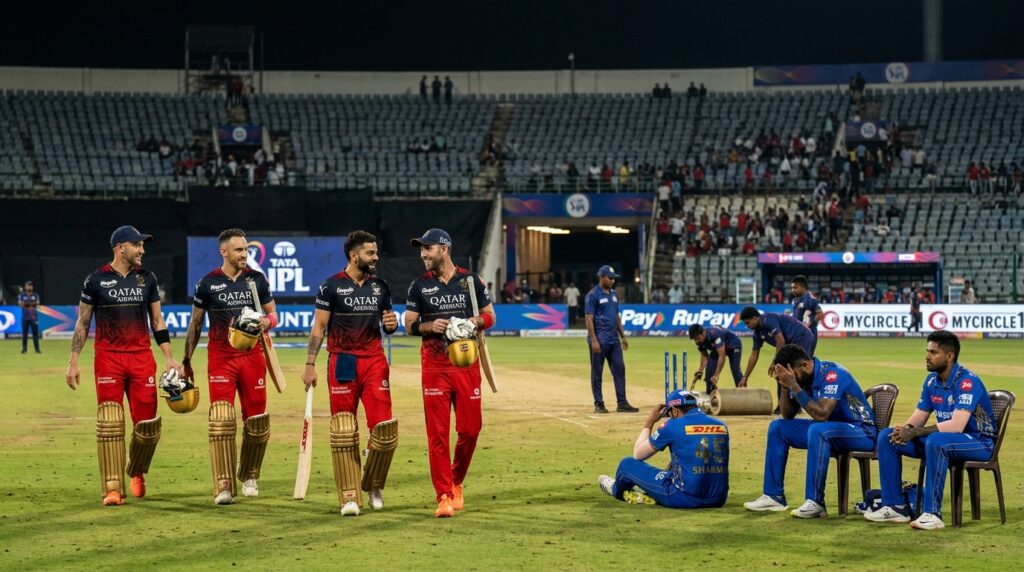
RCB’s two-wicket victory in Raipur lifted them to the top of the 2026 IPL table and ended Mumbai Indians’ fading playoff hopes after another dramatic night in a tightening race for the final four.
Royal Challengers Bengaluru climbed to the top of the Indian Premier League standings with a breathless two-wicket win over Mumbai Indians, completing a last-ball chase that both strengthened RCB’s playoff push and formally ended Mumbai’s hopes of reaching the knockout stage.
The match at Shaheed Veer Narayan Singh International Stadium in Raipur turned into one of the defining contests of the 2026 season, not because either side dominated, but because both refused to give way until the final delivery. Chasing 167 on a surface that rarely allowed fluent strokeplay, Bengaluru stumbled, recovered, nearly collapsed again and finally crossed the line when Rasikh Salam Dar and Bhuvneshwar Kumar scrambled the winning runs amid scenes of confusion and relief.
The victory moved RCB to 14 points from 11 matches, with seven wins and four defeats. Their net run rate, among the strongest in the competition, pushed them above Sunrisers Hyderabad and Gujarat Titans, who were also locked in the upper tier of the table. For Bengaluru, a franchise long associated with high expectations and painful near-misses, the result was not merely another league win. It was evidence of a side capable of surviving pressure, disorder and the kind of late-game tension that often defines championship campaigns.
For Mumbai Indians, the defeat was terminal. The five-time champions slipped to three wins and eight defeats from 11 matches, leaving them unable to force a path back into the playoff race. Their season did not end with a blowout, but with something more punishing: a game they repeatedly seemed to have dragged back within reach, only to lose in the final seconds.
Mumbai had posted 166 for seven after being asked to bat first by RCB captain Rajat Patidar. On a pitch offering grip, uneven bounce and little certainty for batters, that total looked competitive, especially after the way the innings had begun. Bhuvneshwar Kumar struck early and repeatedly, dismantling Mumbai’s top order with a spell that reminded the league of his enduring value in T20 cricket.
He removed Ryan Rickelton, Rohit Sharma and Suryakumar Yadav inside the powerplay, leaving Mumbai wounded at 28 for three. Rohit had briefly threatened to turn the innings with a rapid 22, but Bhuvneshwar’s control of pace and length cut short that momentum. Suryakumar, leading in Hardik Pandya’s absence, fell without scoring, deepening Mumbai’s early crisis.
Tilak Varma and Naman Dhir rebuilt with a partnership that gave Mumbai something to defend. Tilak’s 57 from 42 balls was a composed innings under pressure, balancing caution with timely acceleration. Naman’s 47 from 32 balls gave the innings a harder edge, and together they dragged Mumbai out of immediate danger. Yet RCB’s bowlers kept returning at the right moments. Bhuvneshwar came back to remove Tilak, while Rasikh and Josh Hazlewood helped ensure Mumbai never truly launched in the final overs.
A target of 167 was neither modest nor overwhelming. On another night, with dew, batting depth and a quick outfield, it may have looked below par. In Raipur, it became a test of temperament. RCB’s chase began in the worst possible fashion when Virat Kohli fell for a golden duck. Devdutt Padikkal and Patidar also departed cheaply, leaving Bengaluru 47 for three and giving Mumbai a route back into a match that had almost slipped away in their own innings.
Krunal Pandya then played the innings that held RCB together. His 73 from 46 balls was not a clean, uninterrupted display of power hitting. It was a hard, adaptable innings shaped by conditions and pressure. He absorbed the early damage, rebuilt with Jacob Bethell and then began to attack the angles against spin. Even as cramps visibly troubled him, Krunal continued to find boundaries often enough to keep the required rate within reach.
Mumbai, to their credit, refused to surrender the chase. Corbin Bosch produced a superb spell, taking four wickets and breaking key partnerships just as RCB appeared to be settling. Jasprit Bumrah, as so often in high-pressure moments, compressed the match with a tight penultimate over that left Bengaluru needing 15 from the final six balls. At that stage, Mumbai had the ball in hand, the equation in their favor and the season hanging by a thread.
The final over was a compressed version of Mumbai’s campaign: opportunity, error, revival and heartbreak. Raj Bawa began with extras that gave RCB life, then hit back by dismissing Romario Shepherd. With the match again leaning toward Mumbai, Bhuvneshwar produced the night’s most unexpected stroke, launching Bawa over deep cover for six. It was the kind of shot that transforms a bowler into an all-round protagonist, especially after he had already taken four wickets with the ball.
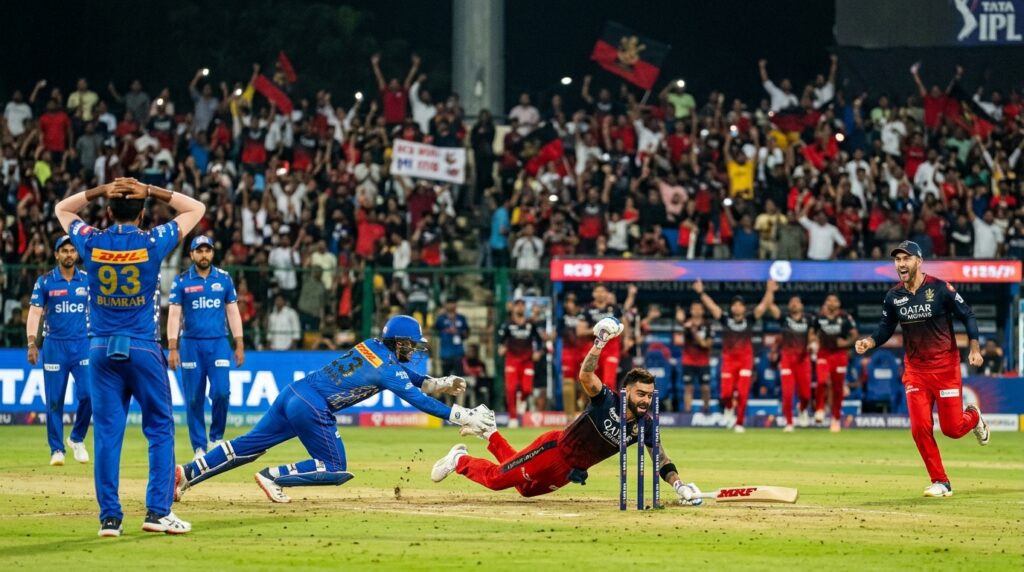
The final ball required two runs. Rasikh struck the ball straight back, and when Mumbai failed to complete the stop cleanly, the batters charged back for the second. The dive, the throw, the missed chance and the eruption from the RCB dugout turned the finish into an image of the season’s tightening margins. Bengaluru had not cruised to the top of the table. They had fought their way there.
That distinction matters. IPL campaigns are rarely linear. Teams rise and fade across travel, injuries, surfaces, form cycles and tactical adjustments. What separates playoff sides is not only talent but their ability to gather points when conditions are awkward and plans unravel. RCB’s win over Mumbai was precisely that kind of result.
It also gave Bengaluru a stronger claim in the race for a top-two finish. In the IPL format, finishing in the top two offers a significant advantage because it gives a team two possible routes to the final. RCB have not yet secured that position, and the table remains crowded, but their momentum is now unmistakable. Their bowling attack has shown control, their lower order has contributed under pressure, and the side has found match-winners beyond its most famous names.
Bhuvneshwar’s performance may prove especially important. In a tournament often shaped by younger power hitters and high-speed fast bowlers, he demonstrated the continuing value of craft. His four for 23 prevented Mumbai from building a larger total, and his late six changed the psychology of the chase. T20 cricket rewards specialists, but its most memorable nights often belong to players who influence the game in unexpected ways.
Krunal’s role was equally central. His innings was a reminder that chases are not always won by the cleanest hitter or the biggest star. They are often won by the player able to read the surface fastest, accept discomfort and choose the right moment to accelerate. His knock became the emotional center of RCB’s chase because it contained both calculation and visible struggle.
For Mumbai, the end of the playoff chase will intensify questions about balance, availability and execution. Injuries and absences played their part, but the table is blunt. Three wins from 11 matches left too little room for recovery. Even in Raipur, where they fought until the last ball, Mumbai’s early batting damage and late bowling errors proved too costly.
The result also changed the tone of the wider tournament. RCB’s move to the top signals that the playoff race is entering its decisive phase, with little separation among the leading sides and every remaining match carrying consequences for seeding. Bengaluru have placed themselves in the strongest possible position, but the challenge now is to convert momentum into qualification, and then qualification into a deep run.
For now, the image that will stay with the season is clear: Bhuvneshwar swinging through the line, Rasikh sprinting back for the second, Mumbai fielders scrambling in desperation and RCB players rushing from the dugout as the chase ended. It was not flawless cricket. It was better than that for Bengaluru. It was resilient cricket, and it carried them to the top of the IPL.