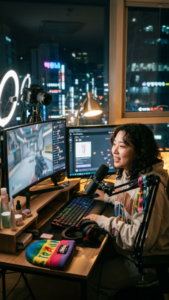
Gaming, shopping, reactions, concerts, talk shows and creator hangouts are converging into a real-time entertainment economy, with TikTok Live now claiming nearly half of measured live-streaming viewership in the first quarter of 2026.
Live streaming, once treated as a noisy corner of gaming culture, is rapidly becoming one of the most important stages in global entertainment. The new center of gravity is not a television studio, a concert arena or an online store, but the glowing, vertical screen where a creator can play a game, sell a serum, react to a trailer, host a comedian, interview a musician and keep thousands of viewers talking in the same chat window.
The latest signal came from Stream Hatchet, the analytics firm owned by GameSquare, which said its first-quarter 2026 live-streaming report now includes TikTok Live data across quarters. With that addition, total quarterly live-streaming viewership reached 17 billion hours watched, and TikTok Live accounted for almost half of all measured live-streaming viewership. Excluding TikTok Live, the market was essentially stable, rising only 0.2% from the previous quarter, according to the company.
The numbers show both the scale and the shift. Twitch remains deeply associated with gaming and esports. YouTube Live has the advantage of search, long-form video libraries, music events and television screens. Kick has pursued streamers and younger audiences with aggressive positioning. But TikTok Live brings something different: a feed-native entertainment machine where live video is inserted into the same habit loop that made short clips dominant.
For viewers, the appeal is immediacy. A game stream is no longer just a broadcast of gameplay; it is a room where jokes, tactics, donations, polls and community rituals happen at once. A shopping stream is not merely a product demonstration; it is a live negotiation over trust, price and social proof. A reaction stream turns a trailer, celebrity interview or political moment into a shared event. A creator hangout can run for hours, even when little appears to happen, because the point is not production polish but presence.
That presence is changing the economics of online fame. In the old creator model, a video was produced, uploaded, optimized and then left to perform. In the live model, the creator is both performer and host, salesperson and moderator, friend and broadcaster. The chat becomes part of the show. Viewers do not simply watch; they ask questions, request songs, challenge opinions, buy products, send gifts and pull the creator toward whatever is happening in the room.
Brands have noticed. Live shopping is especially attractive because it collapses the distance between discovery and purchase. A beauty creator can apply a product, answer questions about skin tone, respond to skepticism and push a limited offer without sending the audience to another platform. A gaming streamer can test hardware in front of viewers who already trust the creator’s taste. A fashion seller can turn inventory into entertainment by making each item reveal feel like an episode.
Concerts and music events are moving in the same direction. Livestreamed festivals and artist performances are no longer simple substitutes for in-person attendance. They are becoming parallel venues, built for fans who want camera choice, backstage access, live comments, merchandise drops and creator-hosted commentary. The living room, the phone and the arena now compete and cooperate at the same time.
Talk shows are also being remade. The traditional late-night format relied on celebrity guests, prepared questions and a fixed schedule. Live creator talk shows are looser and often more unpredictable. A guest can appear from a bedroom, a studio or a tour bus. Viewers can shape the conversation. Clips from the live session can later circulate as short videos, extending the life of the event and feeding viewers back into the next stream.
Reaction content is perhaps the clearest example of live streaming’s cultural power. A major game announcement, film trailer, sports upset or music video release can now generate hundreds of simultaneous mini-broadcasts. Audiences choose not only the event but the person through whom they want to experience it. The result is a layered media environment: the original event, the creator’s response and the audience’s real-time judgment all unfold together.
TikTok Live’s rise matters because it brings this behavior to a mass mobile audience. The platform’s short-video feed trains users to move quickly, but live content encourages them to stay. That combination is powerful. A viewer may enter a livestream by accident, remain because the creator calls out their comment, and return the next day because the stream has become part of a routine. For TikTok, live video deepens engagement. For creators, it offers another path to revenue. For brands, it offers a marketplace with entertainment built in.
The model is not without risk. Live broadcasting is harder to control than edited video. Misinformation, unsafe challenges, harassment, gambling-like gifting behavior and exploitative sales tactics can spread quickly when the incentive is to keep viewers emotionally engaged. Platforms are under pressure to moderate live content in real time, protect minors, disclose paid promotions and make creator payments transparent.
Creator burnout is another concern. Live success often rewards long hours and constant availability. Some streamers build loyal audiences by staying online daily, sometimes for marathon sessions. That can create a fragile business in which income depends on personality, stamina and algorithmic visibility. The more live streaming resembles a full-time entertainment industry, the more it will need professional norms around scheduling, safety, contracts, revenue splits and mental health.
Competition among platforms is likely to intensify through 2026. YouTube has been improving tools for creators who stream across mobile and television screens, including options that let creators go live in vertical and horizontal formats at the same time. Twitch continues to rely on deep gaming culture and community identity. TikTok brings discovery and shopping. Each platform is trying to solve the same problem: how to make live video feel spontaneous while still being reliable enough for advertisers, creators and audiences.
The winners may not be the platforms that host the biggest single events, but those that make live streaming habitual. A major esports final or music festival can produce a huge spike, but the daily economy is built by streamers who return at the same hour, sellers who make live shopping feel personal, and communities that treat a chat room as a third place between work, home and social media.
For media companies, the message is clear. Live streaming is no longer a secondary distribution channel. It is a format with its own grammar: constant interaction, visible audience feedback, flexible length, creator intimacy and instant monetization. For retailers, it is both a sales floor and a stage. For musicians and actors, it is a fan club with cameras. For gamers, it remains a competitive arena, but one increasingly connected to commerce, commentary and celebrity.
The first quarter of 2026 suggests that live streaming is entering a broader entertainment phase. Gaming still anchors the culture, but it no longer defines the limits. Shopping, concerts, reactions, talk shows and creator hangouts are becoming part of the same live ecosystem. The audience is not just watching a screen. It is joining a room, shaping the performance and, increasingly, paying inside the moment.