
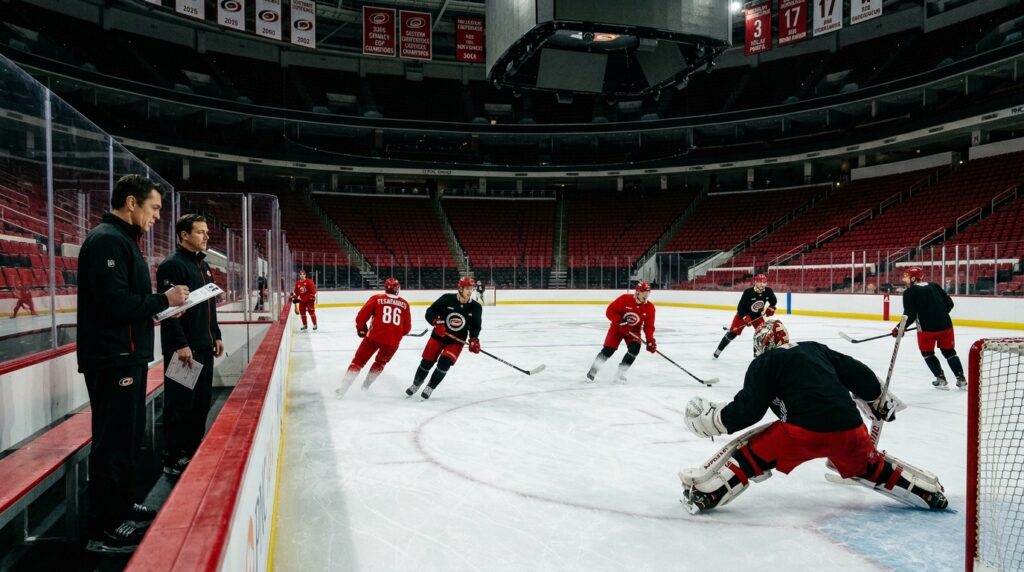
Carolina’s perfect postseason run continued with an overtime victory in Philadelphia, sending the Hurricanes back to the NHL’s final four and deepening expectations around a team built for pressure.
The Carolina Hurricanes have turned a long playoff chase into a statement of force, completing a second-round sweep of the Philadelphia Flyers and returning to the Eastern Conference Final with an unbeaten postseason record that has placed them at the center of the Stanley Cup conversation.
Carolina beat Philadelphia 3-2 in overtime in Game 4 at Xfinity Mobile Arena, closing the best-of-seven series 4-0 and moving to 8-0 in the 2026 Stanley Cup Playoffs. Jackson Blake scored the decisive goal at 5:31 of overtime, finishing a night in which the Hurricanes had to come from behind, absorb a late Philadelphia push and once again rely on the depth and structure that have defined their spring.
The victory sent Carolina to the conference final for the second consecutive season and the third time in four years. It also made the Hurricanes the only undefeated team left in the playoffs, a distinction that reflects more than a hot streak. Through two rounds, Carolina has combined relentless puck pressure, balanced scoring, disciplined defensive layers and elite goaltending into one of the most complete playoff openings in recent NHL history.
The Hurricanes are the first team to sweep through the opening two rounds since the league adopted best-of-seven series in all four playoff rounds in 1987. They are also the fifth team in NHL history to begin a postseason with eight straight wins, joining a short list of dominant clubs and becoming the first to do it since the Edmonton Oilers opened 9-0 in 1985.
For a franchise that has repeatedly pushed deep into the playoffs under coach Rod Brind’Amour but fallen short of the Stanley Cup Final, the sweep was both achievement and warning. Carolina has been here before. The difference this year is the manner of arrival. The Hurricanes have not merely survived two rounds; they have controlled them.
Philadelphia made Carolina work for the final step. The Flyers took a 1-0 lead in the first period when Tyson Foerster scored from the right side, giving the home crowd a reason to believe the series might return to Raleigh. Carolina looked unsettled early, and Philadelphia’s forecheck created the kind of pressure that had been missing for stretches of the series.
But the Hurricanes’ response was familiar. They did not chase the game recklessly. They increased their pace, extended offensive-zone shifts and forced Philadelphia to defend repeated waves of pressure. Blake tied the game in the second period with a shot that deflected through traffic, a goal that restored Carolina’s rhythm and quieted some of the tension around a team trying to finish a sweep on the road.
Logan Stankoven put Carolina ahead early in the third period, continuing his productive postseason and giving the Hurricanes a 2-1 lead. The Flyers answered quickly through Alex Bump, whose one-timer tied the game at 2-2 and turned the final period into a test of nerve. Philadelphia goaltender Dan Vladar kept the Flyers alive with a heavy workload, while Frederik Andersen, at the other end, protected Carolina from the kind of mistake that can extend a series.
In overtime, the Hurricanes’ second line again tilted the game. Taylor Hall, whose postseason has become one of Carolina’s most important storylines, found Blake in the slot. Blake’s wrist shot struck Vladar’s glove and slipped over the goal line, sending Carolina players over the boards and ending Philadelphia’s season.
The goal was Blake’s second of the night and another sign of how much Carolina’s scoring burden has spread beyond its established stars. Hall finished with three assists, Blake had two goals and an assist, and Stankoven added another key finish. In a postseason often decided by checking matchups and special teams, Carolina’s ability to generate offense from multiple lines has given Brind’Amour flexibility that few remaining teams can match.
The Hurricanes have long been known for their system. They forecheck aggressively, deny clean exits, throw pucks toward the net, recover loose rebounds and compress the ice when opponents try to counterattack. That formula can wear down teams over a seven-game series. This spring, it has done something more severe: it has prevented two opponents from finding enough time and space to establish any consistent identity.
Carolina opened the playoffs by sweeping the Ottawa Senators, then carried the same energy into the Flyers series after nearly a week off. Long breaks can create rust, especially for teams that depend on pace and timing. The Hurricanes instead used the rest to refresh their legs and sharpen their details. Their first game against Philadelphia was a 3-0 win, setting the tone for a series in which the Flyers were frequently forced to chase.
Andersen has been central to that control. The veteran goaltender has started all eight playoff games and delivered a level of consistency that has stabilized every other part of Carolina’s game. He entered the conference final stage with an 8-0 record, a 1.12 goals-against average, a .950 save percentage and two shutouts. Just as important, he has rarely allowed opponents to turn stretches of pressure into momentum-changing sequences.
His calm has suited Carolina’s structure. The Hurricanes do not ask their goaltender to survive chaos every night, but when breakdowns happen, Andersen has handled them with efficiency. Against Philadelphia, he made 15 saves in Game 4, including the final stops needed after Bump tied the game. Across eight playoff games, Carolina has allowed only 10 goals.
The sweep also gives Carolina time to prepare for the next opponent. The Hurricanes will face either the Buffalo Sabres or the Montreal Canadiens in the Eastern Conference Final, with that second-round series still ongoing. Carolina will have home-ice advantage after finishing as the top seed in the Metropolitan Division and the East.
Rest can be a double-edged advantage. Carolina will have time to recover, manage injuries and study both possible opponents, but another extended layoff will test its ability to restart quickly. Brind’Amour’s teams are built on repetition and intensity, and maintaining that edge without games is one of the few challenges the Hurricanes have not yet had to solve under heavy pressure this postseason.
Still, the advantage is real. The other Eastern semifinalist will need to survive a longer, more physical series before turning toward Raleigh. Carolina, by contrast, has avoided the accumulated damage that often decides the later rounds of the Stanley Cup Playoffs. The Hurricanes are healthy by playoff standards, confident and rested.
For Philadelphia, the sweep ended a season that had brought progress and renewed belief. The Flyers were competitive in stretches and pushed Carolina into overtime twice, but they could not solve the Hurricanes often enough at even strength and could not slow the waves of pressure when Carolina found its game. The series was tighter in moments than the 4-0 result suggests, but playoff hockey rarely rewards moral margins.
For Carolina, the question now shifts from whether this group can win rounds to whether it can break through the ceiling that has defined the Brind’Amour era. The Hurricanes have been admired for their identity, consistency and culture. They have also been judged by their inability to turn repeated conference-final appearances into a Stanley Cup Final berth.
This run has given them another chance, and perhaps their strongest one. An 8-0 start does not guarantee anything in the NHL, where momentum can be fragile and matchups can change quickly. But it does reveal a team playing with rare balance and conviction.
The Hurricanes entered the playoffs with familiar expectations. They now enter the Eastern Conference Final with something stronger: evidence. They have beaten two opponents without losing once, defended with precision, scored throughout the lineup and found a goaltender in peak form. The next round will ask harder questions. So far, Carolina has answered every one.