
For households using a car every day, the right accessories are not about luxury but preparation, comfort and protection on the road.
For many families, a car is more than a way to get from one place to another. It is a school shuttle, weekend travel companion, mobile storage space, emergency shelter during bad weather and, at times, a temporary dining room for children eating snacks between activities. That daily reality explains why practical car accessories have become increasingly important for family drivers.
The most useful accessories are not always the most expensive or technologically advanced. They are the items that solve common problems: recording what happens on the road, keeping tires properly inflated, protecting children, organizing the cabin, cleaning up messes and helping the driver stay focused. For first-time car owners or families preparing for longer journeys, a small set of carefully chosen accessories can improve safety, convenience and confidence.
A dashboard camera, or dashcam, is often one of the first accessories families consider. Mounted near the windshield, it records the road ahead and, in some models, the rear or cabin as well. Its main value is evidence. In the event of a collision, sudden braking incident, hit-and-run or dispute over traffic responsibility, video footage can help clarify what happened. For parents who share the vehicle with new drivers, a dashcam may also encourage more careful driving.
Families should choose a dashcam based on image quality, reliability and ease of use rather than unnecessary features. Clear daytime and nighttime recording is important, as road incidents do not happen only in perfect light. A wide viewing angle can capture more of the road, but an overly distorted image may make details harder to read. Loop recording, which automatically overwrites older files, helps prevent storage problems. A parking mode can be useful, but it may require proper installation to avoid draining the car battery.
Privacy should also be considered. In some places, audio recording or continuous filming may be subject to local rules. Families who use ride-sharing, company cars or vehicles crossing national borders should understand what is permitted. A dashcam is most helpful when installed cleanly, positioned without blocking the driver’s view and checked regularly to ensure it is actually recording.
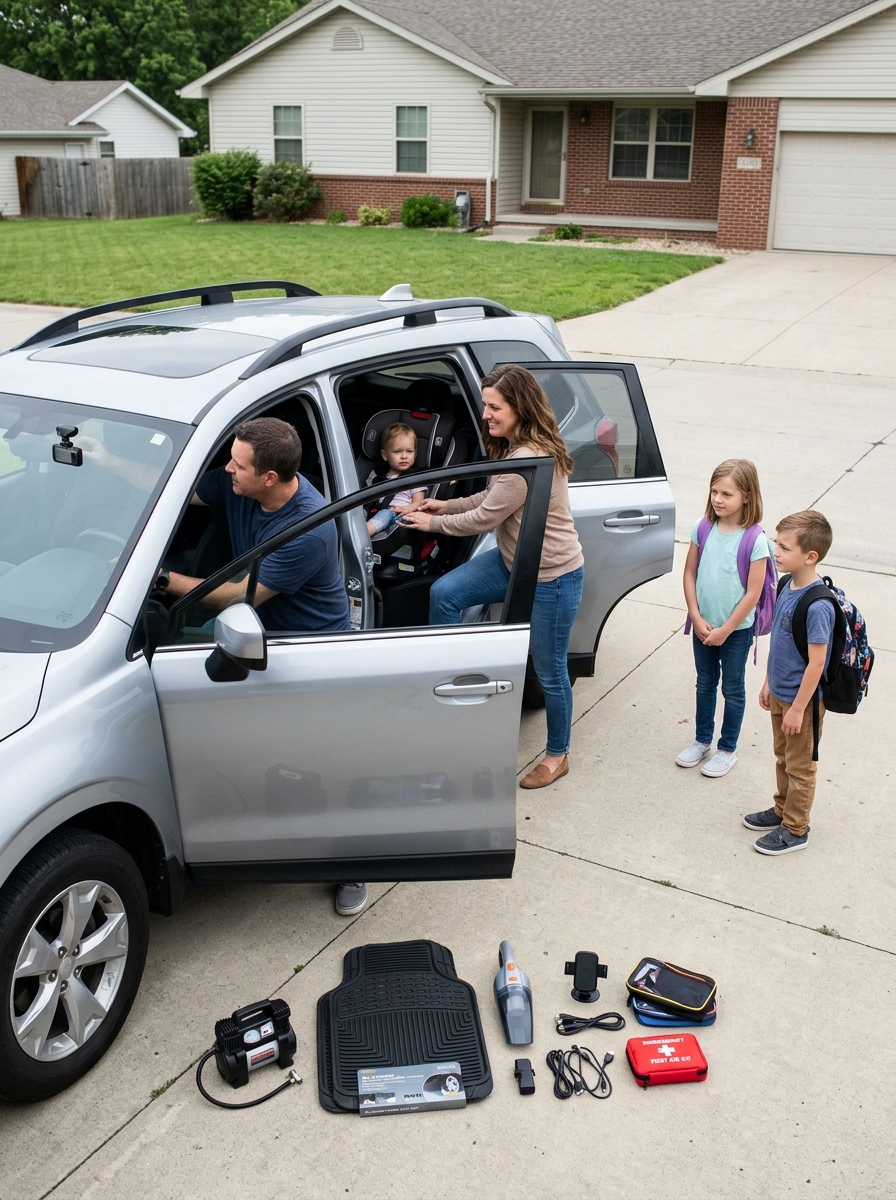
A portable mini tire inflator is another practical accessory that can prevent a minor inconvenience from becoming a stressful roadside problem. Tires naturally lose pressure over time, and underinflated tires can affect fuel economy, handling and braking performance. For families carrying children, luggage, groceries or sports equipment, proper tire pressure is part of basic safety.
Compact inflators powered through a 12-volt socket or rechargeable battery are easy to store in the trunk. The best models include a pressure gauge, automatic shutoff and different nozzles for bicycles, balls or inflatable items. For road trips, an inflator can be especially valuable when a tire looks low in an area without a nearby service station. It is not a substitute for repairing a puncture or replacing a damaged tire, but it can help a driver reach a safer location.
Buyers should check that the inflator can reach the pressure required for their vehicle’s tires and that the hose and power cable are long enough to reach all four wheels. Families should also learn where the recommended tire pressure is listed, usually on a sticker inside the driver’s door area or in the owner’s manual. The most advanced tool is useless if no one knows how to use it before an emergency.
For families with young children, the child car seat is not just an accessory but a critical safety device. Choosing the right seat depends on the child’s age, height, weight and the vehicle’s seating layout. Infant seats, convertible seats, forward-facing seats and booster seats are designed for different stages of growth. A seat that is too large, too small, poorly installed or used with loose straps may not provide the intended protection.
Parents should pay close attention to installation. Many child seats can be fitted using the vehicle’s seat belt or dedicated anchor points, depending on the car and seat design. The seat should be tight, stable and positioned according to the manufacturer’s instructions. Harness straps should sit correctly on the child, and bulky clothing can interfere with proper fit. Used child seats require extra caution because their history may be unknown. A seat that has been in a serious crash, is missing labels or parts, or has passed its expiration date should not be used.
Comfort also matters. A child who is properly supported and seated at the right angle is more likely to remain calm on longer drives. Families should avoid adding aftermarket cushions, strap covers or accessories that were not approved by the seat manufacturer, because they may affect performance in a crash.
Floor mats may seem simple, but they play a major role in keeping a family car usable. Children bring mud, sand, spilled drinks, crumbs and rainwater into the cabin. Durable mats protect the original carpet, reduce odors and make cleaning faster. Rubber or all-weather mats are popular for families because they can be removed, rinsed and dried. Carpet mats may look more refined but are usually harder to clean after heavy use.
The most important safety point is fit. A driver-side mat must not slide forward or interfere with the pedals. It should lock into the vehicle’s floor clips where available and sit flat without curling. Universal mats may be cheaper, but a poor fit can create risk. Families should also avoid stacking mats on top of one another, as this can reduce pedal clearance. In a car used daily by parents and children, good floor mats are less about appearance than long-term protection.
A portable car vacuum cleaner is another useful tool for families. Food crumbs, dust, pet hair and small debris build up quickly, especially in the rear seats. Regular cleaning helps preserve the interior, reduces unpleasant smells and makes the vehicle feel more comfortable. A compact vacuum can be stored at home or in the trunk and used after school runs, beach trips or weekend travel.
When choosing a car vacuum, families should consider suction power, battery life, filter type and attachments. A narrow crevice tool is useful for seat gaps, cup holders and door pockets. A brush attachment can help with fabric seats and floor mats. Cordless models are convenient, but they should have enough battery capacity for more than a few minutes of cleaning. Corded models may be more consistent but depend on access to vehicle power.
A phone holder is also essential in many family cars, especially when navigation apps are used. A secure mount keeps the phone visible without requiring the driver to hold it. This reduces distraction and helps the driver follow directions, monitor traffic and answer calls hands-free where permitted. The key is placement. The phone should be easy to glance at without blocking the windshield, controls or air vents needed for cooling.
There are several types of mounts, including dashboard, windshield, air vent and cup holder designs. Each has advantages and drawbacks. Windshield mounts may offer good visibility but can obstruct the view if placed poorly. Vent mounts are compact but may be unstable on some vent designs and can interfere with heating or cooling airflow. Magnetic mounts are convenient, but the phone must be attached securely. Families should test the mount on rough roads before relying on it during travel.
Beyond these major accessories, families may benefit from a small emergency kit, tissue box holder, trunk organizer, sunshades, charging cables and reusable trash container. But buying too many items can clutter the cabin and reduce comfort. The best approach is to start with the essentials and add only what genuinely solves a problem.
Drivers should also remember that accessories must not compromise safety. Loose objects can become hazards during sudden braking. Items attached to the windshield, dashboard or headrests should be secure and should not block airbags, mirrors or the driver’s view. Electrical accessories should be used carefully, especially when several devices are plugged in at the same time.
For a family, a well-equipped car does not need to look like a showroom demonstration vehicle. It needs to be ready for daily life. A dashcam helps document the unexpected. A tire inflator supports safer travel. A properly chosen child seat protects the youngest passengers. Floor mats and a vacuum keep the cabin clean. A phone holder helps the driver navigate without unnecessary distraction.
The smartest purchases are practical, durable and suited to the family’s real driving habits. Before buying, parents should ask a simple question: will this accessory make the car safer, cleaner, easier to use or better prepared for emergencies? If the answer is yes, it may deserve a place in the vehicle. If the answer is only that it looks attractive online, it may be better left out of the shopping cart.”””
