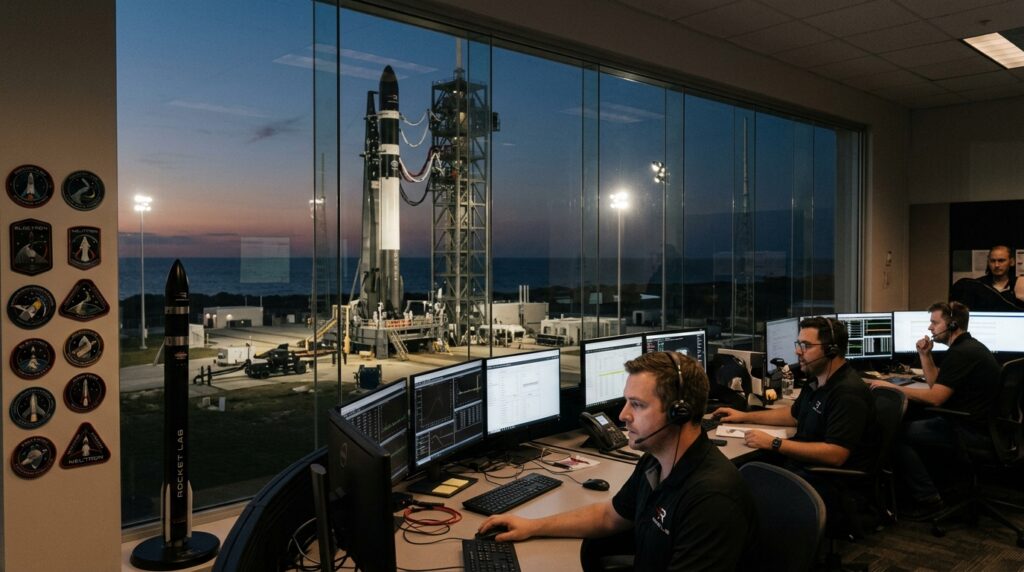
The five-flight Neutron order, paired with three Electron missions for an unnamed customer, gives Rocket Lab a major commercial endorsement before its reusable medium-lift rocket has flown.
LONG BEACH, California — Rocket Lab has announced the largest launch contract in its history, selling a package of five dedicated Neutron launches and three dedicated Electron missions to a confidential customer as the company presses toward the first flight of its new medium-lift rocket in late 2026.
The agreement, disclosed on May 7, marks a significant vote of confidence in Neutron before the rocket reaches orbit. Rocket Lab did not name the customer or disclose the value of the deal, but said the contract exceeds its previous company record, a $190 million block buy for 20 HASTE hypersonic test flights. The new missions are baselined for launch between 2026 and 2029, using both Rocket Lab Launch Complex 1 in New Zealand and Launch Complex 3 at Wallops Island, Virginia.
For Rocket Lab, the order comes at a pivotal moment. The company built its reputation with Electron, a small orbital rocket that has become one of the most frequently flown vehicles in its class. Neutron is its attempt to move into the far larger and more competitive medium-lift market, where customers are seeking capacity for satellite constellations, national security missions, science payloads and commercial infrastructure in low Earth orbit.
Rocket Lab founder and chief executive Sir Peter Beck said the deal showed that launch customers wanted more providers capable of offering reliable and regular access to orbit. His message was clear: the market is no longer satisfied with a narrow set of options for medium-lift missions, particularly as satellite operators plan larger networks and governments increase spending on space-based communications, sensing and defense.
The commercial timing is important. Neutron has not yet flown, and Rocket Lab is still working through the final phases of development, testing and integration. On an investor call, Beck said the company was targeting the fourth quarter of 2026 for Neutron’s first launch, describing the schedule as aggressive. He pointed to ongoing test activity involving the rocket’s structures, separation systems, reusable fairing and Archimedes engines as indicators of progress toward the pad.
Neutron is designed to carry up to 13,000 kilograms to orbit, placing it well above Electron and making it suitable for constellation deployment and heavier government missions. Rocket Lab says the rocket uses carbon composite structures, a reusable first stage and a distinctive fairing design known as “Hungry Hippo,” in which the fairing remains attached to the booster rather than being discarded after payload release. The first stage is powered by nine methane-fueled Archimedes engines, with a vacuum-optimized Archimedes engine on the second stage.
The contract also reinforces Rocket Lab’s three-vehicle strategy. Electron continues to serve small satellite customers that need dedicated launch opportunities rather than rideshare slots. HASTE, derived from Electron, is aimed at hypersonic and suborbital test missions. Neutron is intended to fill the medium-lift gap, giving Rocket Lab a pathway into higher-value contracts and a larger share of government and commercial launch budgets.
The customer’s decision to buy both Neutron and Electron flights suggests a need for flexibility across payload sizes, timelines and launch sites. Electron missions from New Zealand have given Rocket Lab a strong position in responsive small-satellite launches, while Neutron flights from Virginia would place the company closer to U.S. government customers and East Coast launch infrastructure. For a confidential constellation operator or government-linked buyer, that combination could offer a way to stage deployments across multiple vehicle classes.
The financial implications are also notable. Rocket Lab said the deal brings its combined Neutron and Electron launch manifest to more than 70 missions and contributes to an overall backlog of more than $2.2 billion. In its first-quarter 2026 results, the company reported record quarterly revenue of $200.3 million, up sharply from the prior year, and said it had signed 31 new Electron and HASTE contracts in the quarter, along with five new dedicated Neutron launches.
That backlog is central to Rocket Lab’s investment case. Launch companies often face long development cycles, high capital spending and uncertain demand before new vehicles enter regular service. A multi-launch Neutron order before the rocket’s debut gives Rocket Lab stronger evidence that customers are willing to reserve capacity ahead of flight history, though it does not remove the technical and schedule risks that remain.
Those risks are real. Neutron development has already drawn attention after an unintended first-stage tank rupture during testing earlier in 2026 at Wallops. Rocket Lab has said it used the test data to refine the tank design, improve strength margins and manufacturability, and continue work toward the first mission. In the launch industry, test failures are not unusual, but they can affect timelines, investor expectations and customer confidence if they reveal deeper design or production issues.
Rocket Lab’s challenge is to show that Neutron can move from development hardware to repeatable operations. Beck has said that after the first launch, the company would seek to grow cadence gradually, similar to the way Electron scaled from an initial flight to a regular launch business. That path would likely begin with a small number of Neutron missions before increasing as production, engine testing, launch operations and recovery procedures mature.
The market Neutron is entering is both attractive and unforgiving. SpaceX’s Falcon 9 remains the dominant medium-lift commercial rocket, with a high flight rate, reusable boosters and deep customer relationships. Other companies, including Blue Origin, United Launch Alliance, Relativity Space and Firefly Aerospace, are also pursuing or operating launch vehicles aimed at national security and commercial markets. Rocket Lab’s pitch is that many customers want alternatives, especially as satellite constellations multiply and national security agencies emphasize assured access to space.
Assured access has become a defining phrase in the modern launch business. Governments and commercial operators do not want to rely on a single provider, a single launch site or a single supply chain. The war in Ukraine, rising geopolitical competition and the rapid growth of space-based communications have made launch capacity a strategic asset. A successful Neutron would give Rocket Lab a stronger role in that environment, particularly for U.S. defense and civil space missions launched from Virginia.
The company is also becoming more than a launch provider. Rocket Lab builds spacecraft, satellite components, solar power systems, separation systems and other space hardware. Recent acquisitions and product announcements have deepened its vertical integration strategy, allowing the company to sell not only rides to orbit but also the systems that keep satellites operating once they arrive. That broader business could help stabilize revenue if launch schedules shift, but it also adds complexity as Rocket Lab expands across multiple markets.
For the unnamed customer, the secrecy surrounding the contract leaves open several possibilities. The buyer could be a commercial satellite constellation operator, a government agency, a defense-linked program or an entity purchasing capacity on behalf of multiple payload owners. Rocket Lab’s statement did not specify payload type, orbit, mission purpose or pricing beyond saying that launch prices align with the company’s average selling prices for Neutron and Electron.
What is clear is that the customer has reserved a significant amount of capacity before Neutron’s first flight. That is a calculated bet on Rocket Lab’s execution. For Rocket Lab, it is also a public signal to the market that Neutron is no longer only a development program; it is beginning to fill a commercial manifest.
The next test will be hardware, not headlines. Engine firings, vehicle integration, pad rehearsals and regulatory steps must still come together before Neutron can attempt orbit. If Rocket Lab reaches the pad in late 2026, the first flight will be closely watched by customers, competitors and investors looking for evidence that a second major reusable medium-lift option can emerge in the U.S. launch market.
Until then, the five-launch Neutron deal gives Rocket Lab momentum at a crucial stage. It strengthens the company’s backlog, broadens its customer story and raises the stakes for a rocket designed to carry Rocket Lab from the small-launch sector into the center of the commercial and national security space race.
“””