The European Space Agency’s next major exoplanet observatory has emerged from a demanding simulation of space conditions, moving the mission closer to a search for Earth-like worlds around Sun-like stars.
The European Space Agency’s Plato spacecraft has cleared a crucial round of tests designed to prove it can survive and operate in the harsh environment beyond Earth, keeping Europe’s next planet-hunting mission on course for launch aboard an Ariane 6 rocket in early 2027.
The milestone, announced by ESA after the spacecraft emerged from the Large Space Simulator at the agency’s test centre in the Netherlands, marks one of the final major technical checkpoints before Plato is sent to French Guiana for launch preparations. For scientists, it brings closer a mission built around a deceptively simple question: how common are planets like Earth around stars like the Sun?
Plato, short for PLAnetary Transits and Oscillations of stars, is designed to detect and study terrestrial exoplanets, with a particular focus on worlds orbiting in or near the habitable zones of bright, Sun-like stars. Those zones are the orbital regions where temperatures could allow liquid water to exist on a planet’s surface, a condition considered important in the search for potentially life-supporting environments.
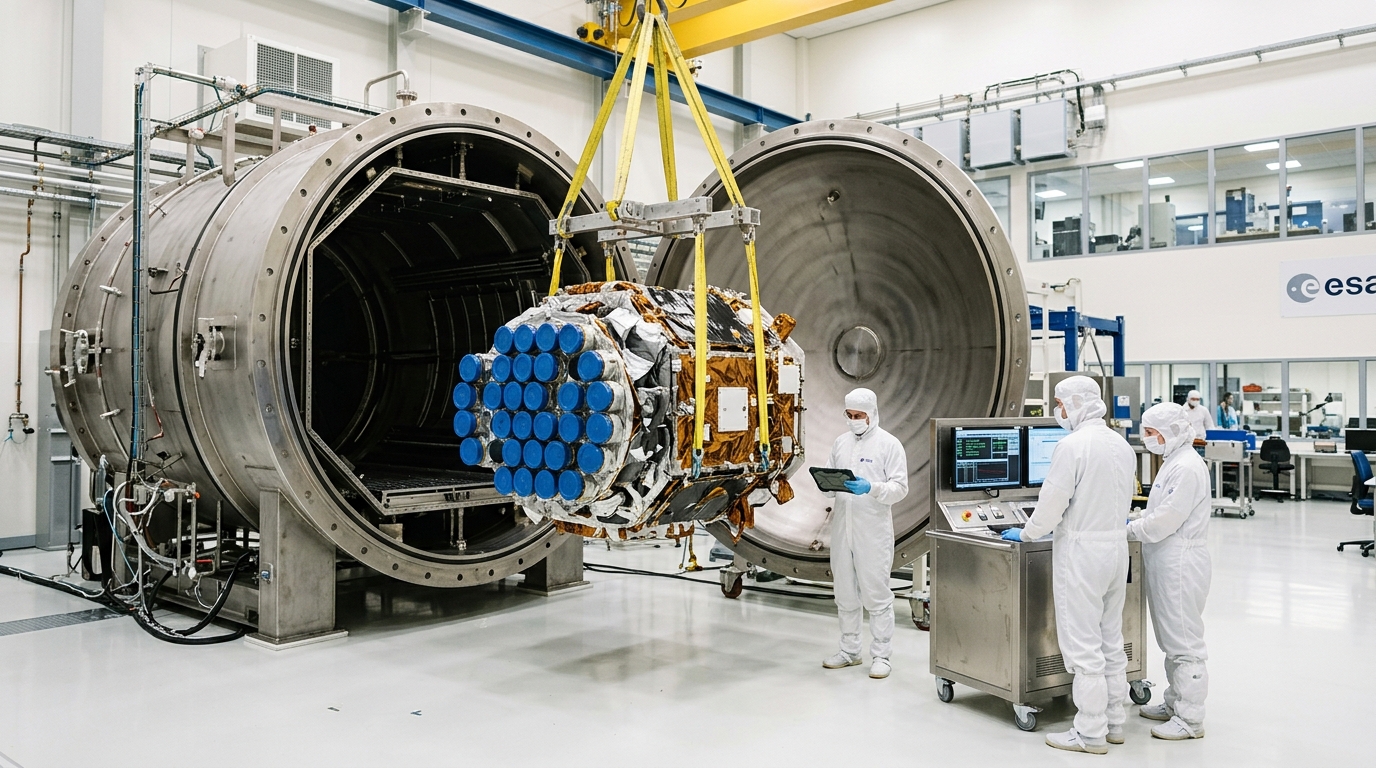
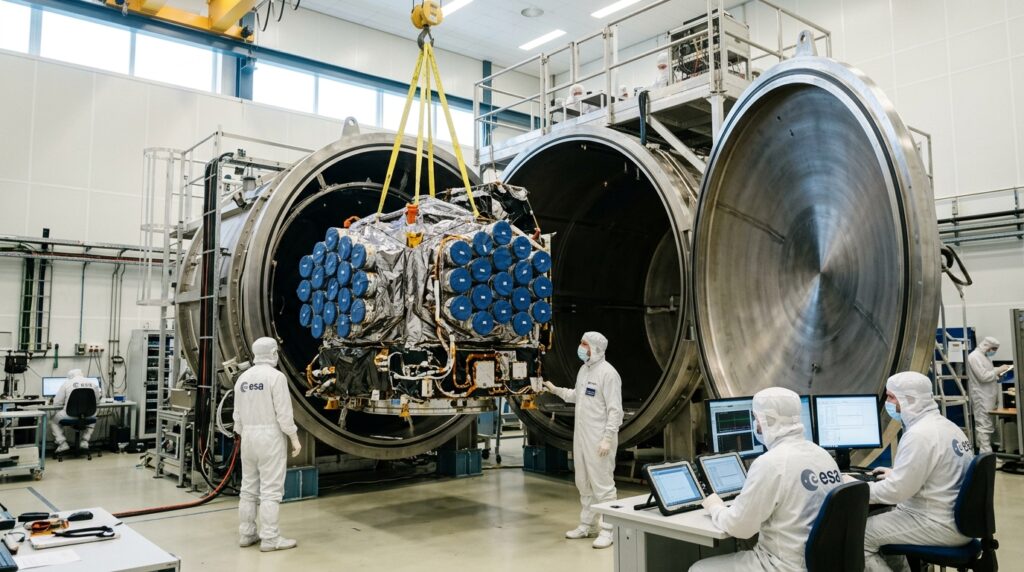
Unlike a conventional telescope built around a single large mirror, Plato carries 26 cameras. Working together, they will monitor vast patches of sky and measure extremely small changes in starlight. When a planet crosses in front of its star as seen from the spacecraft, the star’s light dims slightly. By recording those transits repeatedly and precisely, Plato can help scientists estimate a planet’s size, orbit and, with support from ground-based observations, its mass and density.
ESA says Plato will study more than 200,000 stars, allowing researchers to build a broad catalogue of planets and planetary systems. The mission is expected to pay particular attention to bright stars because they are easier to follow up with telescopes on Earth and in space. Those follow-up observations could help determine whether newly found planets are rocky, gaseous or something in between.
The spacecraft’s latest test campaign took place inside the Large Space Simulator at ESA’s ESTEC facility in Noordwijk. Once the simulator’s hatches were sealed, pumps removed air to create an extreme vacuum, while liquid nitrogen cooled the chamber walls to reproduce the cold of space. Heating elements were then used to mimic the Sun’s effect on Plato’s solar panels and sunshield.
Such testing is not ceremonial. Spacecraft cannot be repaired easily once launched, especially missions destined for deep-space operating points far beyond low Earth orbit. Plato is planned to operate around the Sun-Earth L2 Lagrange point, about 1.5 million kilometres from Earth in the direction away from the Sun. L2 is a favored location for observatories because it offers stable thermal conditions and an unobstructed view of deep space, but it also leaves little margin for hardware failure.
During the test campaign, engineers examined how the full spacecraft performed in normal, hot and cold conditions. In one hot phase, ESA said the solar-panel side of the spacecraft reached 150 degrees Celsius while the cameras, protected by the sunshield and facing the colder side of the chamber, were kept between minus 70 and minus 90 degrees Celsius. In cold phases, heaters had to prevent the instruments from becoming too cold.
The camera tests were especially important. Plato must detect dips in stellar brightness far smaller than the variations visible to the human eye. ESA has said the mission needs to measure changes in luminosity smaller than 80 parts per million to identify and characterize small planets around Sun-like stars. That level of precision requires tight control of the cameras, their focus and the thermal behavior of the spacecraft.
The mission’s scientific power comes not only from detecting transits but also from studying the stars themselves. Plato will use asteroseismology, the analysis of tiny stellar oscillations, to determine properties such as stellar age, size and internal structure. Knowing a star well is essential to knowing its planets well. A planet’s size, orbit and estimated age all depend on the characteristics of the star it circles.
That makes Plato distinct from earlier exoplanet missions. NASA’s Kepler mission revolutionized astronomy by showing that planets are common across the galaxy. NASA’s TESS mission has searched much of the sky for planets around nearby bright stars. Plato is intended to add a sharper focus on Earth-size planets around Sun-like stars and to provide more precise stellar ages, a key missing ingredient in understanding how planetary systems form and evolve.
The spacecraft’s journey to this point has been a long European industrial and scientific effort. Its instruments are supplied through collaboration between ESA and the Plato Mission Consortium, involving research institutes and industries across Europe. The spacecraft is being built and assembled by an industrial team led by OHB, with Thales Alenia Space and Beyond Gravity among the major partners.
Germany has played a prominent role through the German Aerospace Center, which coordinates major scientific contributions and payload work, while France, Italy, Spain, the United Kingdom and other European partners have contributed to the mission’s instruments and science program. The result is a spacecraft whose 26-camera design reflects both the mission’s ambition and the complexity of coordinating a multinational space observatory.
The launch will also be significant for Europe’s space transportation program. ESA and Arianespace signed the launch agreement for Plato in January 2025, selecting Ariane 6 to carry the spacecraft from Europe’s Spaceport in French Guiana. ESA has described Plato as the first science mission that Ariane 6 will launch and the first mission the new European rocket will send toward L2.
For Ariane 6, which is intended to restore and modernize Europe’s independent access to space, carrying a flagship science spacecraft would be a high-profile demonstration. For ESA’s science program, it would continue a long line of European observatories and probes launched to answer fundamental questions about the Solar System, the universe and the conditions that make planets habitable.
Even with the latest test success, work remains. ESA has said engineers and scientists will continue analyzing the data collected inside the simulator over the coming months. That analysis will refine thermal models and help mission teams predict how the spacecraft’s cameras will behave once in flight. Final checks, launch-site processing and integration with the rocket must still be completed before liftoff.
The stakes are scientific rather than commercial, but they are substantial. Astronomers now know of thousands of confirmed exoplanets, yet many of the most important questions remain unresolved. How often do rocky planets form in the habitable zones of Sun-like stars? Are systems like our own common or rare? How do planet sizes, orbits and ages connect to the histories of their host stars?
Plato will not answer every question about life beyond Earth. It is not designed to take images of alien oceans or detect biology directly. But by identifying promising rocky worlds and measuring their stars with unusual precision, it can help define the target list for future observatories that may search planetary atmospheres for chemical signatures.
For now, the spacecraft’s emergence from the Large Space Simulator is a practical victory: the planet hunter has endured an artificial version of the environment it is being built to face. If the remaining preparations hold, Plato will leave Earth in 2027 and begin a mission that could bring astronomers closer to knowing whether the galaxy is filled with other worlds that resemble our own.