
A single note claiming blood ties to the patriarch turns an abandoned child into the center of a family crisis, exposing secrets that money had kept buried for years.
The child was found before sunrise, wrapped in a pale blue blanket and placed carefully beneath the stone arch of the Ellington estate. The security guard first thought it was a bundle of old clothes left by a passerby. Then the blanket moved. A small cry rose through the cold morning air, thin but urgent, and within minutes the quiet mansion at the end of the long driveway was awake.
The baby was no more than a few months old. There was no bag, no milk bottle, no identification card and no name stitched into the blanket. Only a folded piece of paper had been tucked under the child’s tiny hand. The guard carried it inside without opening it, afraid that touching anything more than necessary might disturb evidence. By the time the note reached the breakfast room, the entire Ellington family had gathered in confusion.
At the head of the table stood Victor Ellington, seventy-two, founder of a real estate empire and a man who had spent his adult life avoiding public scandal with the discipline of a banker guarding a vault. His wife, Helena, sat beside him in a silk robe, pale and silent. Their three adult children arrived one after another: Julian, the eldest son and expected heir; Beatrice, a socialite who understood reputation better than loyalty; and Samuel, the youngest, whose debts had made him both desperate and defensive.
Victor unfolded the paper.
It contained only one sentence: “This baby is your blood.”
For a moment, no one spoke. The sentence seemed too short to be dangerous, yet it changed the air in the room immediately. Helena reached for the table as if steadying herself. Julian demanded to see the note. Beatrice asked whether anyone outside the gate had witnessed the discovery. Samuel laughed once, sharply, then stopped when he saw that his father was not laughing.
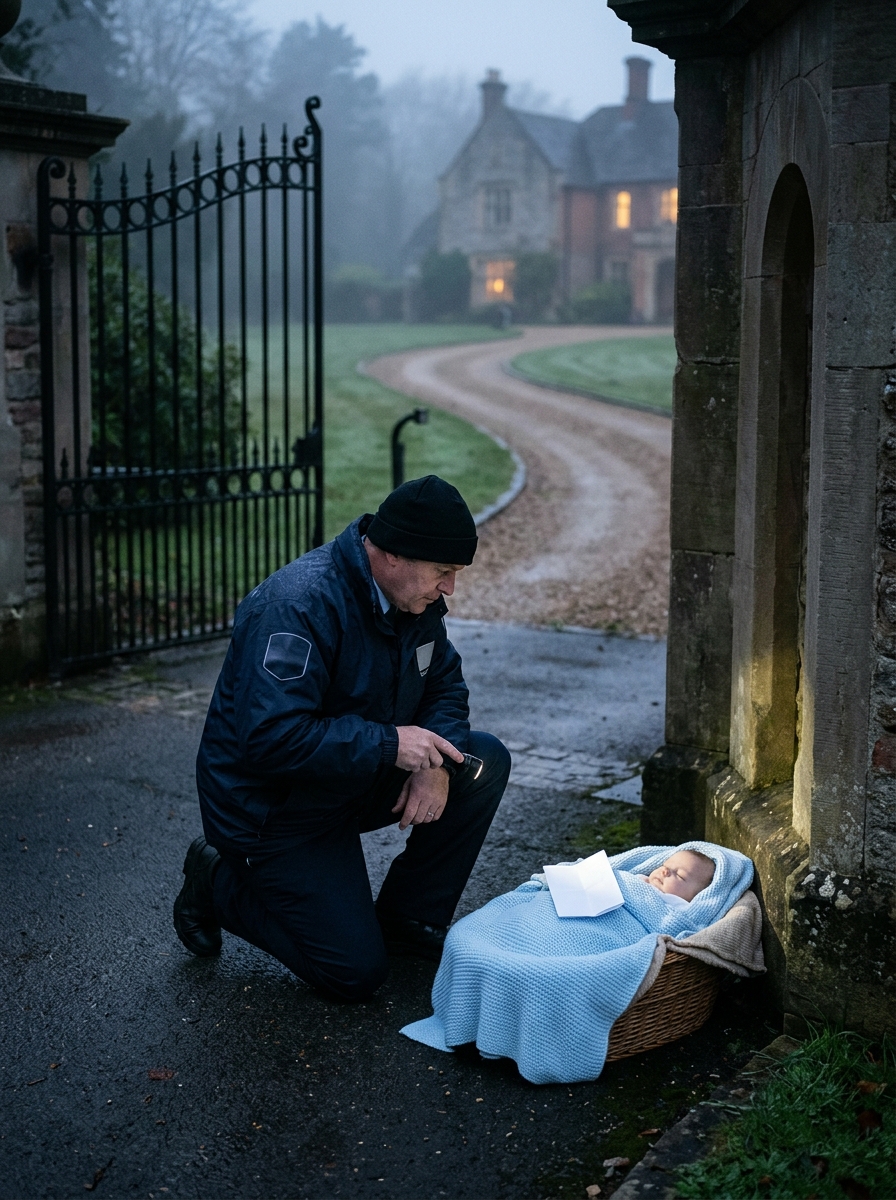
The family called the police and a doctor. The child was examined and found to be tired, hungry and cold, but otherwise stable. Officers took the note, reviewed security footage and questioned the staff. The cameras showed a woman in a hooded coat approaching the gate at 4:13 a.m., placing the bundle near the guard post and walking away quickly. Her face was hidden. Her movements were careful, not panicked. Whoever she was, she had planned the act.
Inside the mansion, suspicion moved faster than the investigation. The note did not say the baby was Victor’s child. It did not say the baby belonged to one of his sons. It did not name a mother. But the phrase “your blood” was intimate enough to wound everyone. In a family built on inheritance, legitimacy and control, blood was not merely biology. It was power.
Julian’s first concern was legal. If the child was connected to Victor, the question of inheritance could change. If the child was connected to Samuel, another scandal might threaten a pending business deal. If the child was the result of an old affair, Helena would face public humiliation after decades of being presented as the elegant force behind the Ellington name. Julian spoke as though the baby were a document that had arrived unsigned.
Beatrice thought first of society. She imagined photographs, headlines, whispered questions at charity dinners and the collapse of the family’s carefully managed image. She wanted the matter handled quietly, through lawyers and private investigators. She suggested placing the child temporarily with an approved agency until “facts were established.” The phrase sounded clean, but it meant distance.
Samuel became angry. He accused Julian of treating everyone like a suspect while ignoring his own secrets. He reminded the room that Julian had traveled constantly, entertained lavishly and acted as if discipline belonged only to others. Julian answered that Samuel’s gambling debts made him the more likely source of disgrace. Within minutes, the abandoned baby had become a weapon in a war that had existed long before the child arrived.
Victor said little. He stood by the window looking toward the gate, where police tape moved lightly in the wind. The note had shaken him in a way his children had never seen. Victor Ellington was a man known for decisive orders, but that morning he appeared to be searching through time rather than facts. Helena watched him closely, and the silence between husband and wife grew heavier than the accusations among their children.
The baby was taken into temporary protective care while the authorities searched for the woman on the footage. Victor, however, insisted that the family cooperate with DNA testing. His children objected for different reasons. Julian feared the result. Beatrice feared the leak. Samuel feared being blamed. Helena said nothing until the room emptied. Then she asked Victor one question: “Is there something you should have told me?”
The answer, when it came, was not simple.
Many years earlier, before the Ellington fortune became untouchable, Victor had been involved with a woman named Mara Vale, a bookkeeper who worked for one of his early companies. The relationship ended when Victor married Helena, but not cleanly. Mara left the city after a financial dispute, and Victor paid a settlement he described as business-related. He insisted he did not know whether Mara had been pregnant. He also insisted he had never seen her again.
Helena listened without interruption. Her face did not change, but the marriage around her did. For more than forty years, she had stood beside Victor at ceremonies, business openings and family portraits. She had accepted his long absences, his private calls and his habit of treating confession as weakness. Now an infant at the gate had done what no argument had managed to do: force the past into the house.
The first DNA results eliminated Julian and Samuel as the baby’s father. That should have brought relief. Instead, it sharpened the fear. A second test confirmed a biological link between the baby and Victor’s paternal line. The child was not Victor’s son. The child was his grandson.
Investigators found the missing connection through old records and a woman who had died six weeks earlier in a provincial hospital. Mara Vale had given birth to a son named Thomas after leaving the city. Thomas grew up without the Ellington name and later worked as a mechanic. He died in an accident shortly before the baby was abandoned. His partner, overwhelmed by grief, poverty and illness, had apparently brought the child to the Ellington estate with the only proof she believed would matter: blood.
The baby had a name. He was Noah.
The discovery did not end the conflict. It changed its shape. Victor had not fathered a secret infant in old age, but he had a grandson whose existence traced back to choices he had buried. Noah’s father had lived and died outside the protection of the family fortune. The child at the gate was not an intruder. He was the descendant of a life Victor had chosen not to examine.
Julian argued that the family had no obligation beyond a financial trust. Beatrice wanted privacy agreements and a carefully worded statement. Samuel, unexpectedly, was the first of the children to hold Noah when he was brought back under supervised arrangements. Perhaps because he knew what it meant to be judged as a problem, he seemed less afraid of the child than the others.
Helena made the decisive move. She visited Noah in the nursery prepared by the household staff and stood over the crib for a long time. Then she told Victor that the child would not be punished for the sins, evasions or cowardice of adults. She had been betrayed by the past, but Noah had not betrayed anyone. If the family name meant anything beyond property, she said, it had to include responsibility.
Victor established legal guardianship proceedings and a trust for Noah, but the more difficult work was personal. He ordered a search for information about Thomas, the son he had never known. Photographs arrived first: a boy with dark eyes, a young man beside a motorbike, a father holding Noah outside a small apartment. Victor studied them late at night. Wealth had trained him to measure loss in assets, but this was different. This was a lifetime he had never counted because he had never allowed it to exist.
The Ellington family did not become peaceful overnight. Julian remained guarded. Beatrice managed the public explanation with controlled elegance. Samuel visited the nursery more often than anyone expected. Helena stayed, but not as the silent wife she had once been. Her forgiveness, if it ever came, would not be automatic.
As for Noah, he became the smallest person in the mansion and the one around whom every hidden truth now turned. He had arrived with no voice except a cry and a sentence on paper. Yet that sentence had broken the family’s discipline of denial. It had forced a powerful household to confront the difference between reputation and responsibility.
The note had said only that the baby was Victor’s blood. In the end, the harder question was whether the Ellingtons could become his family.”””
