
She left her husband’s family home with nothing but a small bag and a broken heart, only to be stopped by a lawyer carrying news that would change everything.
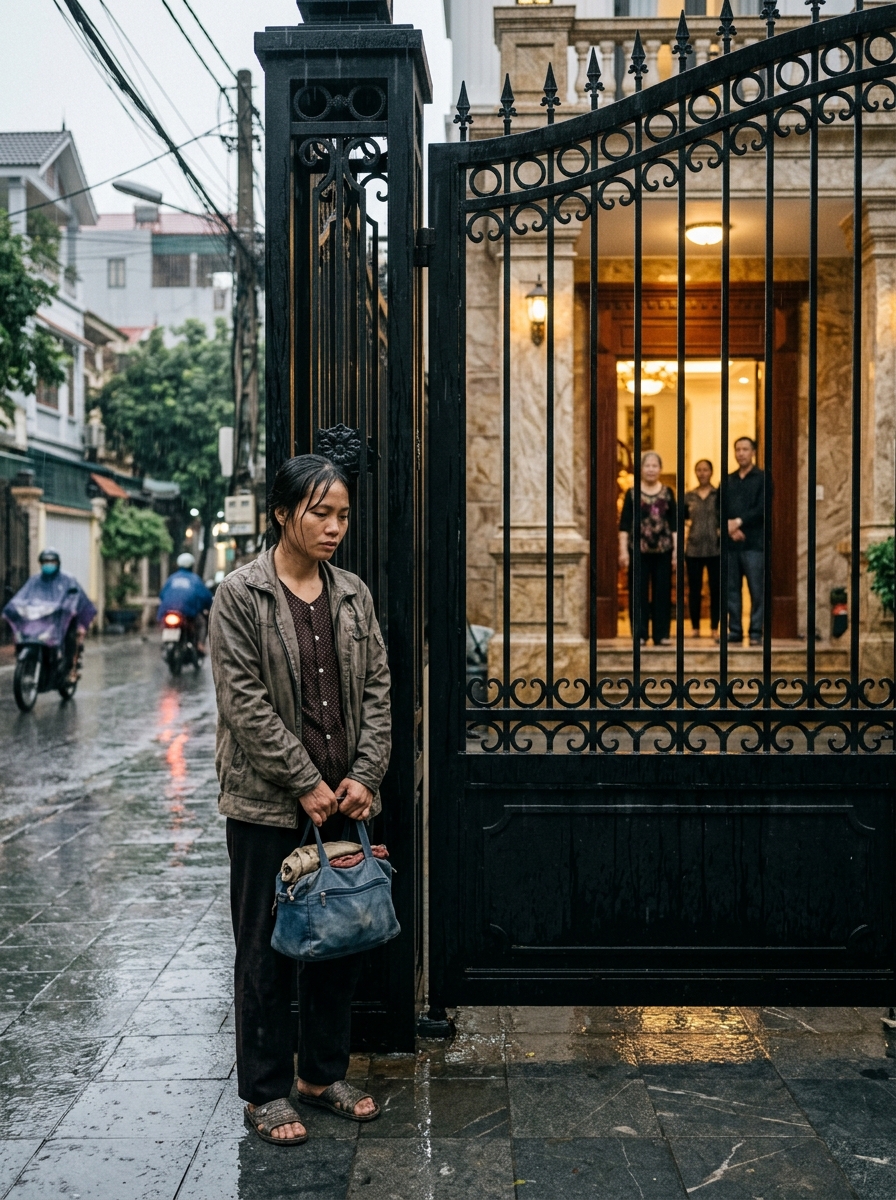
When An stepped out of the iron gate of the Nguyen family villa, she carried only one faded canvas bag. Inside were two dresses, a pair of worn shoes, her identity papers and a framed photograph of her late mother. Everything else she had used during four years of marriage, her mother-in-law said, belonged to the house. Even the suitcase she once brought from her village had been thrown away months earlier because it looked “too poor” to keep in a home of marble floors and crystal lights.
No one came to the gate to say goodbye. Her husband, Huy, stood behind the living room curtains, silent as always. His mother, Mrs. Nguyen, had already turned away after placing the divorce papers on the table and saying, “A woman with no money and no family background should know when to leave with dignity.”
An did not answer. She had learned that in that house, words from a poor woman were treated as noise.
She had married Huy after meeting him at a charity clinic where she worked as an assistant. He had been gentle then, different from his sharp-tongued family. He said he admired her patience, her honesty and the way she helped elderly patients fill out forms without expecting thanks. She believed him. When he proposed, she thought love would be enough to cross the distance between her modest life and his wealthy world.
It was not.
From the first week of marriage, An was reminded that she had entered a family that did not truly accept her. Mrs. Nguyen criticized her clothes, her accent, her village manners and the small wedding gifts her relatives had brought. Huy’s older sister joked that An looked more like a housekeeper than a daughter-in-law. At family dinners, business partners were told that An was “not used to city life,” as if poverty were a permanent defect.
Huy tried to protect her at first, but his resistance weakened. He was the only son, dependent on his mother’s approval and the family company’s money. Each time An was insulted, he lowered his eyes. Each time she cried, he said, “Please endure a little longer.” In the end, the person who promised to hold her hand became the person who watched her stand alone.
The pressure to divorce began after Mrs. Nguyen arranged for Huy to meet the daughter of a real estate investor. The family company needed capital, and marriage, to them, was another form of business negotiation. An was no longer merely unwanted; she had become inconvenient. The divorce papers arrived on a rainy afternoon. The reason written inside was “irreconcilable differences,” though everyone in the house knew the real reason was money.
An signed because she was tired of begging for respect. She did not ask for property, jewelry or compensation. She wanted only to leave before the last pieces of her dignity were taken.
At the gate, rain began to fall lightly. She looked back once at the villa where she had cooked meals, cleaned rooms, cared for her sick father-in-law and waited for a husband who never learned courage. Then she turned toward the road.
A black sedan stopped beside her.
For a moment, An thought Mrs. Nguyen had sent someone to make sure she truly left. But the man who stepped out was unfamiliar. He was in his late fifties, dressed in a dark suit, holding a leather folder under one arm. His expression was formal, but not cold.
“Are you Ms. Le An?” he asked.
An tightened her grip on the bag. “Yes.”
“My name is Tran Minh Duc. I am a lawyer representing the estate of Mr. Pham Van Kien.”
The name struck her like a sound from another lifetime.
Mr. Kien had been an elderly patient at the charity clinic. He came every Tuesday for blood pressure checks, always wearing an old gray jacket despite arriving in a chauffeur-driven car. He spoke little about himself. An helped him fill out medical forms, reminded him to take his medicine and once sat with him for three hours when no family member came after he fainted in the waiting room. Later, she learned he had no children and very few close relatives. To her, he was simply a lonely old man who liked ginger tea and stories about the countryside.
“He passed away six weeks ago,” the lawyer said gently. “Before his death, he left instructions that you be contacted personally.”
An stared at him, confused. “Me? I don’t understand.”
Mr. Duc opened the folder and handed her a sealed envelope. “Mr. Kien named you as the principal beneficiary of his estate.”
The rain seemed to stop making sound.
An thought she had misheard. She looked from the lawyer to the paper in her hand, then back again. “That cannot be right. I was not his family.”
“No,” the lawyer said. “But according to his written statement, you were the only person who treated him like one.”
The estate was not small. Mr. Kien had owned shares in a logistics company, two apartment buildings, land outside the city and several investment accounts. The lawyer explained the details carefully, but An heard only fragments: legal transfer, probate process, verified will, no direct heirs, signed witnesses. The woman who had walked out of her marriage with nothing was now heir to assets worth more than the Nguyen family villa.
She did not feel joy at first. She felt fear. Then disbelief. Then a grief she had not expected. She remembered Mr. Kien’s trembling hands around a paper cup of tea. She remembered him asking once, “Child, do people become invisible when they grow old?” She had answered, “Not to everyone.”
Behind the gate, movement appeared. Mrs. Nguyen had seen the sedan. Huy came out first, followed by his mother and sister. Their faces changed when they recognized the lawyer’s polished car, his formal manner and the documents in An’s hand.
“An,” Huy called, suddenly using a softness she had not heard in months. “What is going on?”
The lawyer turned to her, waiting for permission. An remained silent.
Mrs. Nguyen stepped forward with forced concern. “Why are you standing in the rain? Come back inside. We can talk.”
An almost laughed. One hour earlier, that same woman had told her not to take an umbrella because it had been bought with Nguyen family money.
“There is nothing to discuss,” An said.
Huy looked unsettled. “At least let me help you.”
“You already chose how to help me,” she replied. “You watched me leave.”
The words were quiet, but they landed heavily.
In the weeks that followed, news of An’s inheritance spread through the circles that had once dismissed her. Relatives who had ignored her called to ask if she needed support. Mrs. Nguyen sent messages saying the divorce had been “a misunderstanding caused by stress.” Huy asked to meet several times, writing that he still loved her and that his mother had pressured him. An read the messages but did not answer immediately.
She had no desire for revenge, but she had learned the cost of returning to people who valued her only after discovering her wealth. Money had not changed who she was. It had only changed what others were willing to see.
With the lawyer’s help, An moved into a modest apartment while the estate was processed. She did not buy a luxury car or hold a public celebration. Her first decision was to fund the charity clinic where she had met Mr. Kien. The second was to create a small foundation for elderly patients who had no family support. She named it “The Visible Life Fund,” after the question he had once asked her.
Months later, the divorce was finalized. Huy attended the hearing looking pale and regretful. Afterward, he approached her in the courthouse corridor.
“I was weak,” he said. “I know that now.”
An looked at the man she had once loved and felt sadness, but not longing.
“Yes,” she said. “And I was lonely because of it.”
He asked if they could begin again. She shook her head.
The woman who left the Nguyen home with two hands empty had not become valuable because she inherited land, buildings or money. She had always been valuable. The inheritance only forced the world around her to admit what kindness, endurance and character had already proven.
On the day An signed the final documents transferring part of Mr. Kien’s estate to the foundation, she placed her mother’s old photograph on her desk. Outside, morning light filled the room. For the first time in years, no one was telling her where she belonged.
She had arrived with nothing, they said. But in truth, she had carried the one thing wealth could never buy: a heart that did not become cruel after being wounded.
“””
