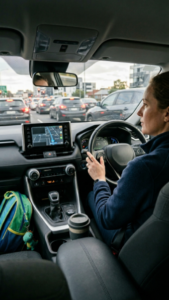
As automakers pack vehicles with screens, sensors and software, the features winning daily loyalty are not the flashiest ones, but the ones that quietly reduce friction, save time and make driving feel less stressful.
NEW YORK — The modern car has become a rolling electronics platform, sold with the language of artificial intelligence, over-the-air updates, digital ecosystems and semi-automated driving. But inside the vehicle, where commuters hunt for a podcast, parents back out of a crowded driveway and delivery drivers navigate unfamiliar streets, the most valuable technology is often far less glamorous.
Drivers do not appear to be rejecting technology. They are rejecting technology that asks too much of them.
Across the auto industry, a clearer pattern is emerging: people use features that solve a familiar problem in one or two steps. They rely on phone mirroring because it brings maps, calls, messages and music into a familiar interface. They use backup cameras because parking is easier with a live view behind the car. They appreciate blind spot alerts because lane changes are stressful. They warm or cool the cabin remotely because nobody enjoys loading a child into a freezing or overheated vehicle.
The technology that succeeds is not necessarily the most advanced. It is the technology that disappears into routine.
That distinction matters as carmakers race to turn vehicles into software-defined machines. A new car can now recognize a driver, adjust seat and climate preferences, stream entertainment, accept app-based payments, update itself overnight and assist with steering and braking in traffic. Some of those features are genuinely useful. Others risk becoming digital clutter: clever in a product demonstration, forgotten after three weeks of ownership.
The smartphone remains the strongest proof of what drivers actually want. Apple CarPlay and Android Auto have become central to the driving experience because they reduce the learning curve. A driver who already knows how to use a phone does not want to relearn navigation, contacts and audio through a separate automotive operating system. The phone provides continuity. The car provides the screen, speakers and steering-wheel controls.
That is why the debate over native infotainment systems versus phone projection has become so emotional. Automakers want more control over data, subscriptions, mapping, charging routes and the customer relationship. Drivers often want the shortest path to a trusted map and a familiar playlist. For many households, the question is not whether the car has a beautiful interface. It is whether the driver can get directions to a dentist appointment without pulling over to decode a menu.
Navigation is one of the clearest winners. Real-time traffic, accurate arrival estimates, lane guidance and charger or fuel-stop routing have made built-in and phone-based navigation more than a convenience. It changes behavior. Drivers leave later, choose different routes, avoid congestion and coordinate pickups by sharing arrival times. In electric vehicles, route planning can also reduce anxiety by telling drivers when and where to charge. A map that saves 12 minutes on a Tuesday can earn more loyalty than a feature described as futuristic.
Parking technology has followed a similar path. Backup cameras moved from premium novelty to everyday expectation. Parking sensors, cross-traffic alerts and 360-degree camera views are not exciting in the showroom, but they matter in tight garages, apartment ramps and school lots crowded with children. Their value is immediate because the driver understands the problem before the technology is explained.
Blind spot monitoring and blind spot cameras also show why useful technology is often simple technology. A light in the mirror or a camera view in the instrument cluster does not ask the driver to trust a machine completely. It adds information at a moment when visibility is limited. The driver remains responsible, but the uncertainty is reduced. That is a powerful formula for adoption.
Comfort features are another quiet success. Heated seats, ventilated seats, heated steering wheels, automatic climate control and remote cabin preconditioning rarely define a vehicle’s public image, but they shape daily satisfaction. They are used because they address physical discomfort quickly. Smart climate systems that learn preferences may be less dramatic than automated lane changes, but they can make a car feel personally useful rather than merely computerized.
Voice control remains more complicated. Drivers like the idea of speaking instead of tapping, especially for calls, messages and navigation. The problem is consistency. A voice assistant that understands a natural request can reduce distraction. One that fails twice in traffic becomes a source of irritation. The arrival of more conversational artificial intelligence may improve the experience, but the car is a demanding environment: noisy, time-sensitive and safety-critical. A voice system that works 90% of the time can still feel unreliable if the missing 10% occurs at the wrong moment.
Driver-assistance systems occupy the most sensitive territory. Adaptive cruise control, lane centering and traffic-jam assist can reduce fatigue, especially on long highway drives or in slow congestion. Many drivers who learn their limits become loyal users. But the limits are the point. These systems are assistance, not autonomy, and their value depends on clear communication. If the car drifts, brakes unexpectedly, loses lane markings or asks the driver to retake control without warning, confidence can disappear quickly.
The best driver-assistance technology behaves like a disciplined co-pilot. It helps, but it does not pretend to replace judgment. The worst version encourages confusion: a steering wheel that feels automated one moment and helpless the next, a warning chime that arrives too late, or a brand name that suggests more capability than the system can safely deliver.
Automatic emergency braking may be less visible but more consequential. Most drivers hope never to notice it. Its value is in the rare moment when a vehicle, pedestrian or sudden stop appears faster than a human reaction. Unlike entertainment features, safety systems are judged by prevention, not delight. The strongest safety technologies become trusted because they do not demand constant interaction.
The touchscreen backlash is also revealing. Drivers are not asking to return to the 1990s. They are asking for a hierarchy of controls. A large screen can be excellent for maps, cameras and media. But basic functions such as wipers, hazard lights, defrosting, temperature and volume benefit from physical switches, knobs or fixed controls that can be found by touch. When a simple task requires a sequence of taps through nested menus, the technology has failed the driver even if the screen looks modern.
This has become a design and safety issue, not merely a matter of nostalgia. Regulators and safety organizations are increasingly focused on distraction, and automakers are beginning to acknowledge that all-digital interiors can go too far. The most usable cabins are likely to be hybrids: digital where flexibility helps, physical where speed and muscle memory matter.
Digital keys and app-based vehicle controls are gaining ground for the same reason. They are useful when they remove small inconveniences. Unlocking a car with a phone, checking whether the doors are locked, locating the vehicle in a large parking lot or starting climate control remotely can become habitual. But these systems must be dependable. A dead phone, weak signal, software glitch or subscription wall can quickly turn convenience into resentment.
In-car payments, gaming screens, gesture controls and passenger displays face a higher bar. Some may find real use in specific contexts, especially charging, parking and tolls. But technology that does not solve a repeated problem risks becoming a showroom flourish. Families, commuters and fleet drivers are practical judges. They remember the feature that helped them reverse safely in the rain. They forget the feature that required a tutorial.
The lesson for automakers is not to stop innovating. It is to measure innovation by use, not spectacle. The future car will almost certainly be more connected, more electric and more software-driven. But the winners will be companies that understand the difference between capability and usefulness.
Drivers already know what they want. They want maps that work, cameras that clarify, alerts that help without nagging, climate controls they can operate instantly, safety systems that intervene only when needed and phone integration that does not fight their habits. They want technology that respects the fact that driving is not a screen session. It is motion, weather, traffic, passengers, risk and time.
The car tech people actually use has a common trait: it makes the driver feel more capable, not more managed. In an industry often tempted by complexity, that may be the most important innovation of all.