
From Monaco’s narrow streets to Monza’s high-speed straights, Formula 1 is decided not only by the driver’s courage, but by engineering precision, tyre choices and split-second decisions from the pit wall.
A Formula 1 Grand Prix often appears, at first glance, to be a contest of speed. Twenty cars line up on the grid, engines rise into a sharp mechanical chorus, the lights go out, and the fastest machines in circuit racing surge toward the first corner. But beneath that spectacle lies a more complex truth. Modern Formula 1 is not won by speed alone. It is won by the alliance of driver, machine, data, tyres, timing and nerve.
Every Grand Prix is a moving laboratory. The cars are designed to the edge of regulation and physics, shaped by aerodynamics, energy recovery, suspension geometry, brake temperatures and tyre behavior. Yet the result is still decided in public, under pressure, with rivals just meters away and millions watching. That tension is what gives Formula 1 its distinctive drama: the sport is both highly scientific and deeply human.
The famous circuits give each race its personality. Monaco is the jewel and the trap, a glamorous street circuit where barriers sit close enough to punish the smallest mistake and overtaking is notoriously difficult. Monza, the “Temple of Speed,” rewards low drag, powerful acceleration and bravery under braking. Silverstone combines history with fast, flowing corners that test aerodynamic balance. Spa-Francorchamps stretches through the Ardennes with elevation changes, unpredictable weather and corners that have become part of racing mythology. Suzuka, with its figure-eight layout and demanding sequence of bends, remains one of the purest examinations of rhythm and precision.
No two circuits ask the same question. At Monaco, qualifying can be almost as important as the race because track position is precious. At Monza, slipstreaming and braking efficiency can open chances to attack. At Singapore, heat, humidity and the proximity of walls test concentration. At Spa, clouds can turn one side of the circuit wet while another remains dry. The calendar is therefore not a repetition of races, but a traveling examination in adaptation.
At the center is the driver, alone in the cockpit yet never truly alone. A Formula 1 driver must manage violent acceleration, heavy braking loads, tyre temperatures, battery deployment, fuel usage, brake balance and radio instructions while fighting wheel-to-wheel at more than 300 kilometers per hour. The steering wheel is not simply a steering wheel. It is a command center, allowing the driver to adjust settings corner by corner and respond to changing conditions in real time.
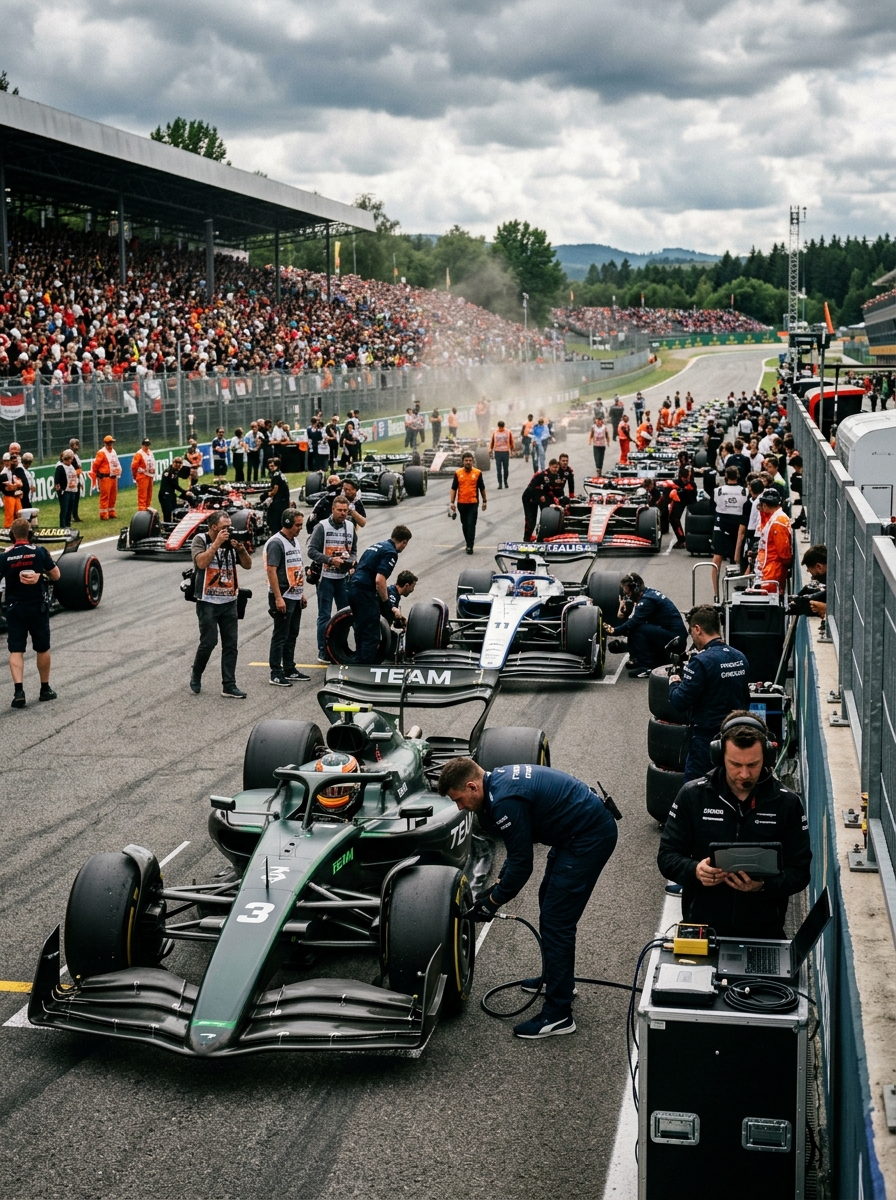
But the driver’s brilliance depends on the unseen work of hundreds. Long before race day, engineers simulate tyre wear, aerodynamic efficiency, weather probabilities and competitor behavior. Mechanics build, strip and rebuild cars with forensic attention. Strategists study past races, practice data and pit lane time loss. Analysts examine whether a car is faster in clean air or capable of following another car through turbulent airflow. By Sunday, the team has prepared several possible races before the real one begins.
The pit wall is where those possibilities are narrowed into decisions. From a row of screens, team principals, race engineers and strategists follow timing sectors, tyre degradation, weather radar, rival pit stops, traffic gaps and safety car risk. Their language is calm because it has to be. A decision made in panic can destroy an afternoon. A decision made one lap too late can turn victory into second place.
Tyres are often the strategic heart of a Grand Prix. Softer compounds generally provide more grip and faster lap times, but wear more quickly. Harder compounds last longer, but may take time to warm up and can cost performance. The central question is always the same: when is fresh rubber worth the time lost in the pit lane?
That question produces the famous tactical moves of Formula 1. The undercut is a direct attack: a driver pits earlier than a rival, uses fresh tyres to set faster laps, and hopes to emerge ahead once the rival stops. The overcut is more patient: a driver stays out longer, uses clear air or better tyre life to gain time, then pits later. Neither tactic is automatically correct. Its success depends on tyre warm-up, traffic, track temperature, pit crew execution and the rival’s response.
A pit stop is one of the most compressed acts in global sport. The car arrives at high speed, stops precisely on its marks, and mechanics change four tyres in seconds. The image is almost choreographed: front jack, rear jack, wheel guns, tyre carriers, release signal, acceleration back into the lane. But the beauty of a pit stop is also its danger. A slow wheel nut, an unsafe release, a delay behind another car or a badly timed call can cost positions that no amount of speed can recover.
This is where technology and teamwork become inseparable. Sensors stream information from the car. Engineers watch temperature curves and energy profiles. Strategists calculate gaps measured in tenths of a second. But the driver must still execute the out-lap, bring the tyres alive, avoid mistakes and attack or defend at the right moment. Formula 1 rewards information, but it punishes hesitation.
Competition between drivers adds another layer. Teammates may share data and equipment, but they are also measured against each other more brutally than against anyone else. A driver can lose a race to a rival team and still survive politically. Losing consistently to the driver in the same garage is far more damaging. Within every team, cooperation and ambition exist in uneasy balance.
Between teams, the battle is broader. A car that dominates one circuit may struggle at another. Upgrades can change the competitive order. A new floor, front wing or suspension adjustment can bring a tenth of a second per lap, which over a race distance can become the difference between controlling the field and fighting in traffic. The season is not only a sporting championship, but an engineering arms race under strict limits.
Weather can overturn all predictions. A few drops of rain can force teams to decide whether to gamble on intermediate tyres, stay out on slicks or wait for heavier rain. The first driver to choose correctly can gain half a minute. The first driver to choose wrongly can slide off the track. Wet races expose instinct as much as calculation because data arrives only after the risk has already begun.
Safety cars and virtual safety cars add further uncertainty. A pit stop under normal racing speed may cost significant time. Under a safety car, when the field slows, that loss can shrink dramatically. A driver who receives a timely safety car can gain a “free” stop. Another who pitted just before it may feel punished by chance. Strategy, in Formula 1, is partly science and partly survival.
The emotional power of a Grand Prix comes from this accumulation of variables. A driver may lead from pole and control every lap. Another may start outside the top ten, extend a stint, benefit from a safety car and fight onto the podium. A team may lose because it chose the wrong tyre. A rookie may become a hero by resisting pressure from a champion. A champion may be exposed by one lock-up, one slow stop or one misread cloud on the radar.
That is why famous victories often remain memorable not only for speed, but for judgment. The best Formula 1 races feel like chess played at racing speed. Every move creates a counter-move. Every lap changes the value of the next decision. Fans watch the timing screens almost as closely as the cars because the race may be shifting before the overtake is visible.
Yet for all its technology, Formula 1 still returns to the human face at the end. A driver climbs from the cockpit exhausted, sweat-soaked and shaking with adrenaline. Mechanics lean over barriers to celebrate or stare at the floor in disappointment. Engineers replay the calls they made and the ones they almost made. On the podium, the medal and trophy belong to the driver, but the victory belongs to a system.
A Grand Prix is therefore not merely a race. It is an argument between risk and control, instinct and data, bravery and calculation. The car must be fast, but speed must be protected by strategy. The driver must attack, but not destroy the tyres. The team must trust its models, but also read the race as it changes in front of them.
When the lights go out, Formula 1 becomes louder than any spreadsheet. But beneath the roar, every lap is speaking in numbers, temperatures, gaps, degradation curves and human decisions. The winner is the one who hears all of it clearly enough to reach the chequered flag first.
