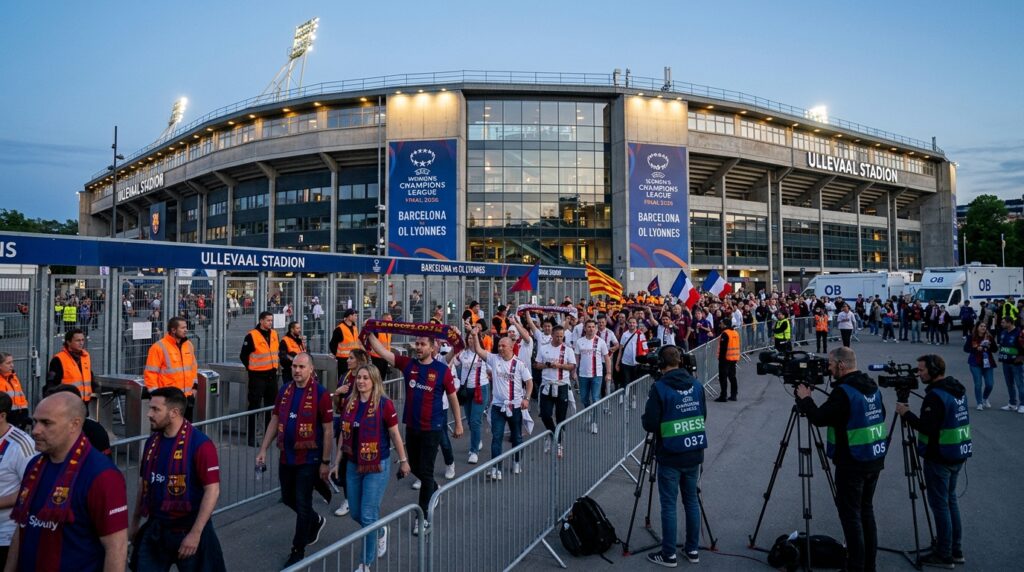
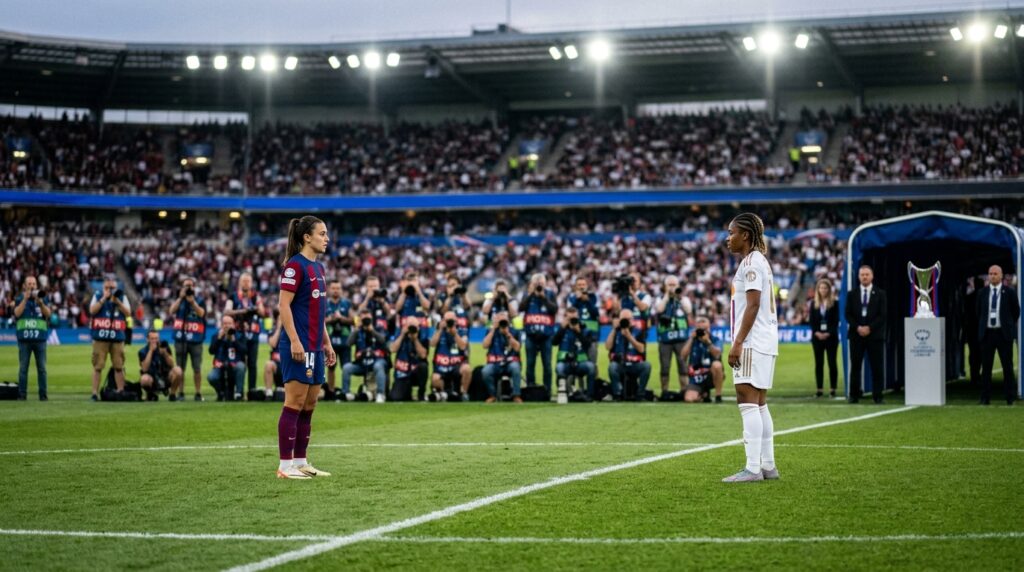
The UEFA Women’s Champions League final at Ullevaal Stadion on May 23 will bring together the modern power of Barcelona and the record pedigree of OL Lyonnes in a fourth title match between the clubs.
OSLO — Barcelona and OL Lyonnes will meet in the 2026 UEFA Women’s Champions League final at Ullevaal Stadion in Oslo on May 23, setting up another chapter in the rivalry that has shaped the top level of European women’s club football for much of the past decade.
The match, scheduled for an 18:00 CET kickoff, will close the 2025/26 season with the competition’s two most recognizable forces facing each other again. Barcelona arrive as the dominant club of the current era, having reached a sixth consecutive final and a seventh in eight seasons. OL Lyonnes, the record eight-time European champion, return to the showpiece for a 12th time, extending a standard of continental consistency few teams in any version of the sport have matched.
The final will be the first UEFA women’s club competition decider staged in Norway. Ullevaal Stadion, the regular home of Norway’s women’s and men’s national teams, gives the match a symbolic setting in a country with a deep connection to women’s football. It also adds a local dimension through OL Lyonnes forward Ada Hegerberg, the Norwegian striker who remains the all-time leading scorer in the competition and could chase another European title on home soil.
For Barcelona, the final is an opportunity to reinforce a dynasty that has been built through technical control, relentless pressing and attacking depth. The Spanish champions have won three Women’s Champions League titles, including their breakthrough 4-0 victory over Chelsea in 2021, their comeback win against Wolfsburg in 2023 and their 2-0 defeat of OL Lyonnes in Bilbao in 2024. They lost last season’s final to Arsenal, a result that interrupted but did not fundamentally alter their position as one of the game’s defining teams.
Their route to Oslo underlined that status. Barcelona finished top of the new league phase table and then eliminated domestic rivals Real Madrid 12-2 on aggregate in the quarter-finals. In the semi-finals, they overcame Bayern München 5-3 across two legs after a 4-2 home win in the second leg, a match in which Alexia Putellas scored twice and Salma Paralluelo and Ewa Pajor also found the net. The return of Aitana Bonmatí from injury added another emotional and sporting lift to a squad already loaded with experience.
OL Lyonnes reached the final by a more dramatic route. The French side finished second in the league phase on goal difference and then showed its resilience in the knockout rounds, overturning first-leg deficits in both the quarter-finals and semi-finals. After defeating Wolfsburg 4-1 on aggregate following extra time, OL Lyonnes beat defending champion Arsenal 4-3 over two legs. Jule Brand’s late winner in the second leg against Arsenal, set up by Melchie Dumornay and confirmed after a lengthy VAR review, sent the French club to Oslo.
The matchup is rich in history. OL Lyonnes beat Barcelona in the 2019 final in Budapest, racing into an early lead on the way to a 4-1 victory marked by Hegerberg’s first-half hat trick. They defeated Barcelona again in Turin in 2022, winning 3-1 against a team that had entered the final as holder and favorite. Barcelona responded in 2024 in Bilbao, beating OL Lyonnes 2-0 to claim a long-sought victory over the club that had previously represented the benchmark they were trying to surpass.
That history gives the Oslo final more weight than a single match. It is not merely a meeting of two strong teams, but a contest between two models of sustained excellence. OL Lyonnes built the original modern empire of European women’s club football, combining elite recruitment, tactical sophistication and a winning culture that turned Champions League finals into familiar territory. Barcelona’s rise came later, powered by the club’s technical identity, institutional investment and a generation of players who brought Spanish women’s football to the center of the global game.
The tactical contrasts will be closely watched. Barcelona are likely to seek long spells of possession, using midfield rotations and wide overloads to draw opponents out of shape. Their attack can flow through Putellas, Bonmatí, Caroline Graham Hansen, Mariona-style movement from wide areas and the penalty-box instincts of Pajor. When Barcelona control rhythm, they can suffocate opponents by keeping the ball and then pressing immediately after losing it.
OL Lyonnes bring a different kind of threat. Their European tradition is built on physical authority, transition speed and the ability to manage decisive moments. Wendie Renard remains an imposing defensive and set-piece presence, Christiane Endler offers calm behind the back line, and Dumornay has emerged as one of the most influential attacking midfielders in the competition. With Hegerberg, Kadidiatou Diani and Brand among the attacking options, OL Lyonnes can punish opponents quickly if Barcelona leave space behind their full-backs.
The coaches add another layer. Barcelona’s Pere Romeu is set to face Jonatan Giráldez, the former Barcelona coach now leading OL Lyonnes. Giráldez helped shape Barcelona’s recent success before moving on, and his knowledge of the club’s principles could matter in a final likely to be decided by details. Romeu, meanwhile, has had to maintain Barcelona’s standard while adapting to the pressures that come with managing a team expected to reach and win finals every year.
The final also reflects the changing structure of the competition. This season introduced a new 18-team league phase, replacing the old group-stage format and creating a broader, more demanding road to the knockout rounds. Barcelona and OL Lyonnes both finished among the top four, moving directly to the quarter-finals, while other clubs were forced through playoff ties. The format was designed to increase competitive balance and provide more high-profile matches, but the final pairing suggests that, at the summit, Europe’s established powers remain extremely difficult to dislodge.
For UEFA and the wider women’s game, Barcelona against OL Lyonnes is close to the ideal commercial and sporting fixture. It brings star players, a clear rivalry, contrasting histories and a venue that can frame the occasion as a continental event rather than a club match detached from its setting. Oslo’s hosting role also reinforces the tournament’s geographic reach, taking the final to a Nordic country with its own legacy of elite women’s football.
The stakes are different for each club. Barcelona can strengthen the case that they have become the dominant European team of this generation, especially after falling short in the 2025 final. Another title would confirm their ability to respond to disappointment and sustain excellence through injuries, tactical adjustments and squad evolution. For OL Lyonnes, victory would reassert the authority of Europe’s most decorated women’s club and prove that their era is not merely a matter of history.
The presence of Hegerberg in Norway will attract particular attention. Few players are more closely identified with the rise of the Women’s Champions League as a global spectacle, and few have had a greater impact on its biggest matches. A final in Oslo gives her the possibility of adding another defining moment in front of a home crowd, though Barcelona’s defense will understand the danger of allowing sentiment to become momentum.
For Barcelona’s Ballon d’Or winners and OL Lyonnes’ serial champions, the final will likely be decided not by reputation but by execution under pressure. Set pieces, transitions, goalkeeper decisions, substitutions and VAR interventions have all shaped recent knockout matches. In a rivalry where both sides know what it means to win and lose against the other, the psychological margin may be as narrow as the tactical one.
When the teams walk out at Ullevaal Stadion, the occasion will carry the memory of Budapest, Turin and Bilbao, but it will also point toward the next phase of the women’s club game. Barcelona and OL Lyonnes have already defined much of the competition’s modern history. In Oslo, they will decide whether the present still belongs to Barcelona’s golden machine or whether OL Lyonnes can reclaim the summit they occupied for so long.
“””