
Peaking in early May, the annual display offers a visible reminder that Earth is still crossing dust left behind by the solar system’s most famous comet.
For a few hours before dawn in early May, the sky will offer one of astronomy’s most accessible events: a meteor shower that requires no telescope, no observatory and no specialist training. The Eta Aquariids of 2026 are expected to reach their broad maximum around the night of May 5 into the morning of May 6, when Earth moves through a stream of dust associated with Halley’s Comet.
The event is not a storm of stars, and the name itself can be misleading. The streaks are not stars falling from space. They are tiny fragments of cometary material, most no larger than grains of sand, colliding with Earth’s atmosphere at extraordinary speed. For the Eta Aquariids, that speed is about 65 kilometers per second, fast enough to produce bright, brief lines of light and, in some cases, glowing trails that linger for several seconds.
What makes the Eta Aquariids especially appealing is their connection to 1P/Halley, the comet that has been recorded by human observers for centuries and last swept through the inner solar system in 1986. Halley itself will not return to the neighborhood of Earth until 2061, but its debris returns to public view twice every year. In May, that debris produces the Eta Aquariids. In October, another crossing of Halley’s trail gives rise to the Orionids.
A comet is often described as a dirty snowball, but that simple phrase hides a dynamic process. As Halley approaches the Sun, heat causes ice locked in its nucleus to vaporize, releasing dust and small rocky particles into space. Over many orbits, those particles spread along the comet’s path like a thin river of debris. Earth does not have to meet the comet itself to create a meteor shower. It only needs to pass through the trail the comet has left behind.
That is what happens each year in early May. As Earth moves along its orbit, it intersects Halley’s old dust stream. The particles hit the upper atmosphere, heat the air around them and vaporize. The light we call a meteor is the visible result of that violent but tiny encounter. From the ground, the streak appears silent and delicate. In physical terms, it is an atmospheric flash caused by a high-speed collision.
The Eta Aquariids take their name from the star Eta Aquarii in the constellation Aquarius. This does not mean the meteors come from that star. The name refers to the radiant, the point in the sky from which the meteors appear to spread outward because of perspective. The particles are traveling along parallel paths, but to an observer on Earth they seem to fan out from the direction of Aquarius, much as railway tracks appear to converge in the distance.
In 2026, the shower will be active for several weeks, from late April into late May, but the best opportunity will cluster around the mornings near May 6. The maximum is broader than some meteor showers, meaning observers may still have a reasonable chance on mornings immediately before and after the predicted peak. That flexibility matters because weather, haze and light pollution can decide whether a skywatching plan succeeds.
Viewing conditions this year will not be perfect. A bright waning gibbous Moon, about 84 percent illuminated, will wash out many of the fainter meteors. Under ideal dark skies, the Eta Aquariids can produce up to about 50 meteors per hour, especially for observers in the Southern Hemisphere and tropical latitudes. In 2026, moonlight is expected to reduce the visible count significantly. For many observers in the Northern Hemisphere, the number may be closer to a handful or fewer than 10 per hour.
That should not discourage casual skywatchers. Meteor showers are not only about totals. A single bright Eta Aquariid crossing a quiet sky before sunrise can be more memorable than a statistical prediction. These meteors are known for speed, and fast meteors can produce long, elegant paths, especially when they enter the atmosphere at a shallow angle. In northern latitudes, some may appear as “Earthgrazers,” skimming low along the horizon with unusually extended trails.
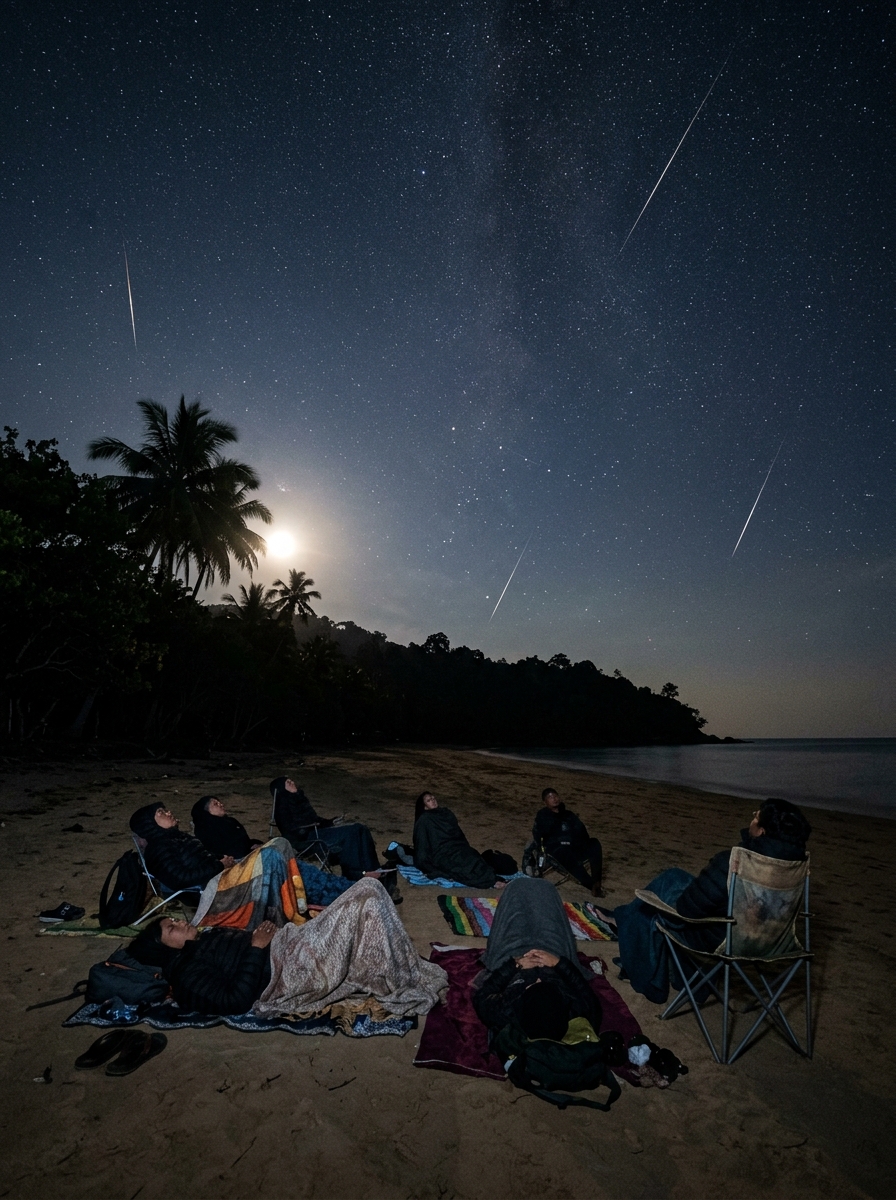
For viewers in Vietnam and other parts of Southeast Asia, the practical advice is simple: choose the early morning hours before dawn, preferably around 3 a.m. until the sky begins to brighten. The radiant in Aquarius rises in the eastern sky during the pre-dawn period, so an open eastern or southeastern horizon is helpful. But observers should not stare only at Aquarius. Meteors can appear anywhere overhead, and the longest trails often show up some distance away from the radiant.
The best observing site is one away from city lights, high-rise buildings and direct glare. Rural beaches, open fields, mountain viewpoints and dark suburban edges are better than brightly lit streets. Because the Moon will be bright, it helps to place a building, hill, tree line or wall between your eyes and the Moon while keeping a wide view of the sky. The goal is not to magnify the meteors. It is to protect your night vision.
No telescope is needed. In fact, a telescope is the wrong tool for a meteor shower because it narrows the field of view. Binoculars are also unnecessary. The human eye, given time to adjust, is best suited to scanning a large portion of the sky. Observers should lie back on a mat, reclining chair or blanket, keep warm enough to remain comfortable, and avoid looking at phone screens. Night vision can take 20 to 30 minutes to develop and can be lost quickly under bright light.
Photography is possible but more demanding. A camera on a tripod, a wide-angle lens, long exposures and repeated shots can catch meteors if the sky is dark enough. Even then, the eye may see meteors the camera misses. For most people, the better approach is patient observation rather than equipment. Meteor watching rewards stillness.
The Eta Aquariids also offer a useful lesson in scale. Halley’s Comet is far away and invisible now, yet dust it shed long ago continues to interact with Earth. Some particles entering the atmosphere in 2026 may have been released from the comet many centuries ago. A meteor lasting less than a second can therefore be the final visible moment of material that has traveled through the solar system for generations.
That connection helps explain why meteor showers remain powerful public science events. They show that Earth is not isolated. Our planet moves through a solar system filled with old trails, fragments and histories. A meteor shower is astronomy without abstraction: orbital mechanics becomes a flash of light; comet dust becomes a personal experience; the deep past appears above an ordinary horizon.
The Eta Aquariids of 2026 may be partly dimmed by moonlight, but they remain worth watching. They are a reminder that Halley’s Comet has not vanished from human experience between its rare returns. Each May, it leaves a message written not as a visible comet, but as brief strokes of fire in the morning sky.
For anyone willing to wake before dawn, find a dark place and look up patiently, the reward is not only the chance to count meteors. It is the chance to witness Earth passing through the invisible wake of one of history’s most famous celestial visitors.
