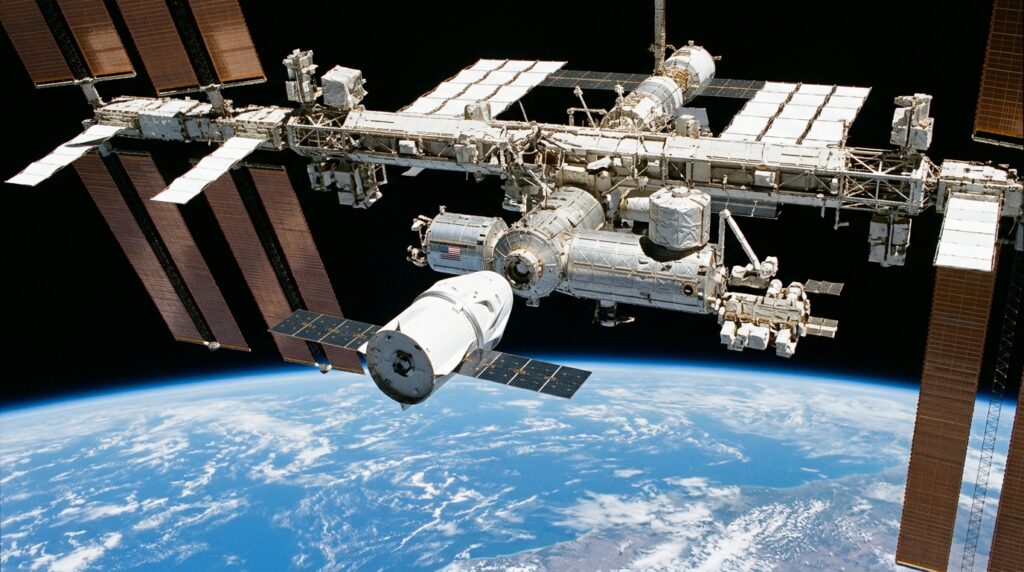
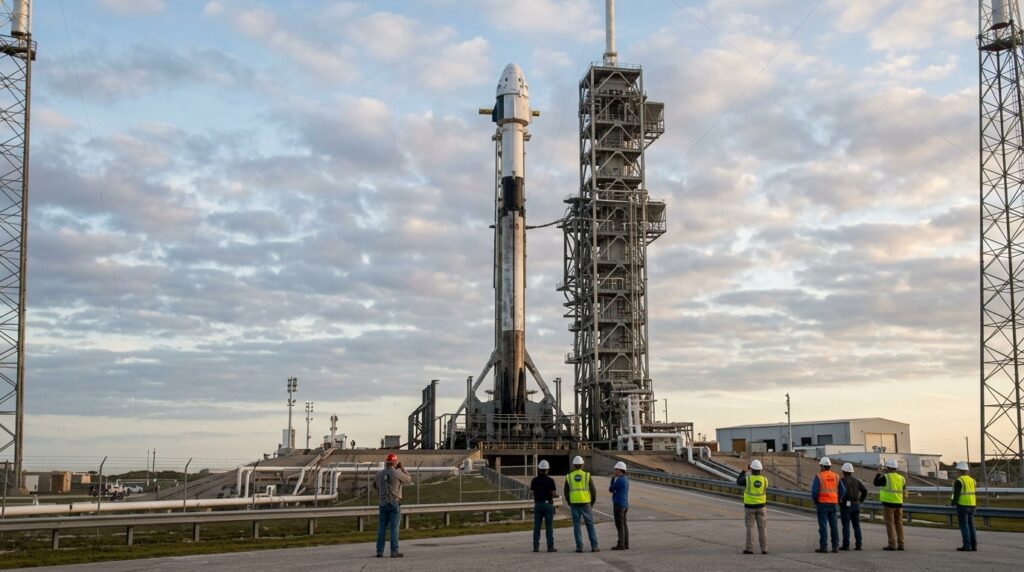
A SpaceX Dragon spacecraft is set to carry about 6,500 pounds of science, hardware and crew supplies to the International Space Station, extending NASA’s reliance on commercial cargo flights for orbital research.
NASA and SpaceX are preparing to launch the CRS-34 cargo mission to the International Space Station, a flight that underscores how routine resupply has become central to the United States’ human spaceflight program and to the scientific work conducted in orbit.
The mission is scheduled to lift off at 7:16 p.m. EDT on Tuesday, May 12, from Space Launch Complex 40 at Cape Canaveral Space Force Station in Florida. A SpaceX Falcon 9 rocket will carry the company’s Dragon cargo spacecraft on the 34th SpaceX commercial resupply services mission for NASA, with a backup launch opportunity available the following day if weather, technical issues or range conditions prevent liftoff.
Dragon is loaded with about 6,500 pounds of cargo, including crew supplies, station hardware and new scientific investigations. After an orbital chase lasting roughly two days, the spacecraft is expected to dock autonomously at about 9:50 a.m. EDT on Thursday, May 14, to the forward port of the station’s Harmony module.
The flight is not a crewed launch, but it is an essential part of keeping the orbiting laboratory active. The International Space Station depends on a steady chain of cargo vehicles to deliver food, equipment, replacement parts and experiments. Without those missions, astronauts could not maintain the pace of research, repair aging systems or test technologies needed for deeper exploration.
NASA’s commercial cargo program was designed to move routine station resupply into the hands of private companies while allowing the agency to focus on exploration, science and technology development. SpaceX’s Dragon has become a key part of that system because it can deliver cargo to the station and return experiments and equipment to Earth, a capability that remains important for biological samples, materials research and hardware inspections.
CRS-34 comes at a time when the station is serving both near-term research needs and long-term exploration goals. For more than 25 years, the ISS has functioned as a laboratory in microgravity, supporting thousands of investigations by researchers from more than 100 countries. The work aboard the station helps scientists understand how the human body, materials, fluids, plants and microorganisms behave when the constant pull of gravity is removed.
Among the experiments heading to orbit is ODYSSEY, a project that will compare how bacteria behave in actual microgravity with how they behave in Earth-based simulators designed to mimic space conditions. Such comparisons matter because ground simulators are widely used before experiments are launched. If researchers better understand where those simulators succeed or fall short, they can improve how space biology studies are designed on Earth.
Another investigation, called Green Bone, will examine how bone cells grow on a scaffold made from wood. NASA says the experiment could support research into fragile bone conditions, including osteoporosis. The study also carries direct relevance for astronauts, who can lose bone density during long stays in microgravity. Understanding how bone cells develop in space may help scientists design better treatments for patients on Earth and better countermeasures for crews traveling beyond low Earth orbit.
Dragon will also carry SPARK, an investigation focused on red blood cells and the spleen. Spaceflight can alter multiple body systems, including blood volume, immune response and the way cells are produced and broken down. By studying human samples and related imagery before, during and after flight, researchers hope to identify changes that could affect astronaut health on long-duration missions to the Moon, Mars and beyond.
The mission’s science manifest also includes STORIE, short for Storm Time O+ Ring current Imaging Evolution. The instrument is designed to monitor charged particles around Earth that respond to space weather. These particles are part of the planet’s near-space environment and can affect satellites, communications systems and power infrastructure. Better knowledge of how they behave could help scientists improve forecasts of space weather disturbances.
Another experiment, Laplace, will study the motion and collision of dust particles in microgravity. On Earth, gravity quickly dominates the behavior of small particles. In orbit, researchers can observe interactions that may resemble processes in early planetary systems, where dust grains collide, stick together or drift apart. Such studies can help scientists examine how planets and other bodies may have formed from clouds of material around young stars.
The cargo also includes CLARREO Pathfinder, an Earth science instrument intended to take highly accurate measurements of sunlight reflected by Earth and the Moon. The project is designed to improve the accuracy of climate-related measurements and demonstrate calibration techniques that could help other Earth-observing sensors. In climate science, small measurement errors can complicate long-term trend analysis, making calibration a critical part of observing a changing planet.
Beyond the science payloads, CRS-34 will deliver practical station hardware. NASA’s cargo list includes replacement and spare parts for life-support and maintenance systems, including equipment related to water recovery, oxygen generation, station inspection and pressure hull repair capability. Such items rarely attract public attention, but they are crucial to keeping the orbital complex functioning safely.
One cargo item is a catalytic reactor component for the station’s Water Recovery and Management System. The system helps recycle wastewater, reducing the amount of water that must be launched from Earth. Dragon will also carry equipment connected to the station’s waste and hygiene systems, vibration monitoring, ultrasonic inspection and gas reserves. These supplies reflect the operational reality of the ISS: science depends on plumbing, air, power, spare parts and careful logistics.
NASA astronaut Jack Hathaway and European Space Agency astronaut Sophie Adenot are expected to monitor Dragon’s arrival from the station. Although Dragon is designed to dock autonomously, crew members and ground teams track the approach closely, ready to respond if the spacecraft or station requires a change in procedure. Autonomous docking has become a normal feature of Dragon missions, but each arrival still involves a detailed sequence of navigation, communications and safety checks.
SpaceX says the Falcon 9 first-stage booster assigned to CRS-34 is making its sixth flight and is expected to return to Landing Zone 40 at Cape Canaveral after stage separation. Reusing boosters has become a standard part of SpaceX’s launch model, helping the company sustain a high flight rate for government, commercial and Starlink missions. For NASA cargo flights, that operational cadence supports the broader goal of maintaining dependable access to the station.
Dragon is scheduled to remain at the ISS until mid-June, when it will depart with time-sensitive research and cargo for return to Earth. NASA says returning hardware will include an ocular imaging device used to monitor crew eye health, a sorbent bed that filters trace contaminants from cabin air and other station equipment. The Advanced Plant Habitat, which supported long-duration plant biology studies, is also scheduled to come back for eventual museum display.
The ability to return experiments quickly is one reason Dragon remains especially valuable to researchers. Some biological samples and materials must be recovered, preserved and analyzed soon after landing. A splashdown off the coast of California gives teams a path to retrieve cargo and move it to laboratories for detailed study.
CRS-34 is one mission in a long sequence, but it captures the broader transformation of low Earth orbit. The ISS is no longer supported only by government-operated spacecraft. It now depends on a commercial supply chain involving private launch vehicles, reusable spacecraft, university experiments, international partners and NASA mission managers.
That model is expected to shape the future of orbital research as NASA prepares for eventual commercial space stations after the ISS era. Each cargo flight is therefore both a delivery run and a rehearsal for a more commercially operated low Earth orbit economy.
For now, the immediate objective is straightforward: launch Dragon safely, guide it to the station, unload its cargo and return critical research to Earth. Behind that routine lies the larger purpose of the space station program — using a laboratory 250 miles above the planet to answer questions that cannot be studied the same way on the ground.”””