
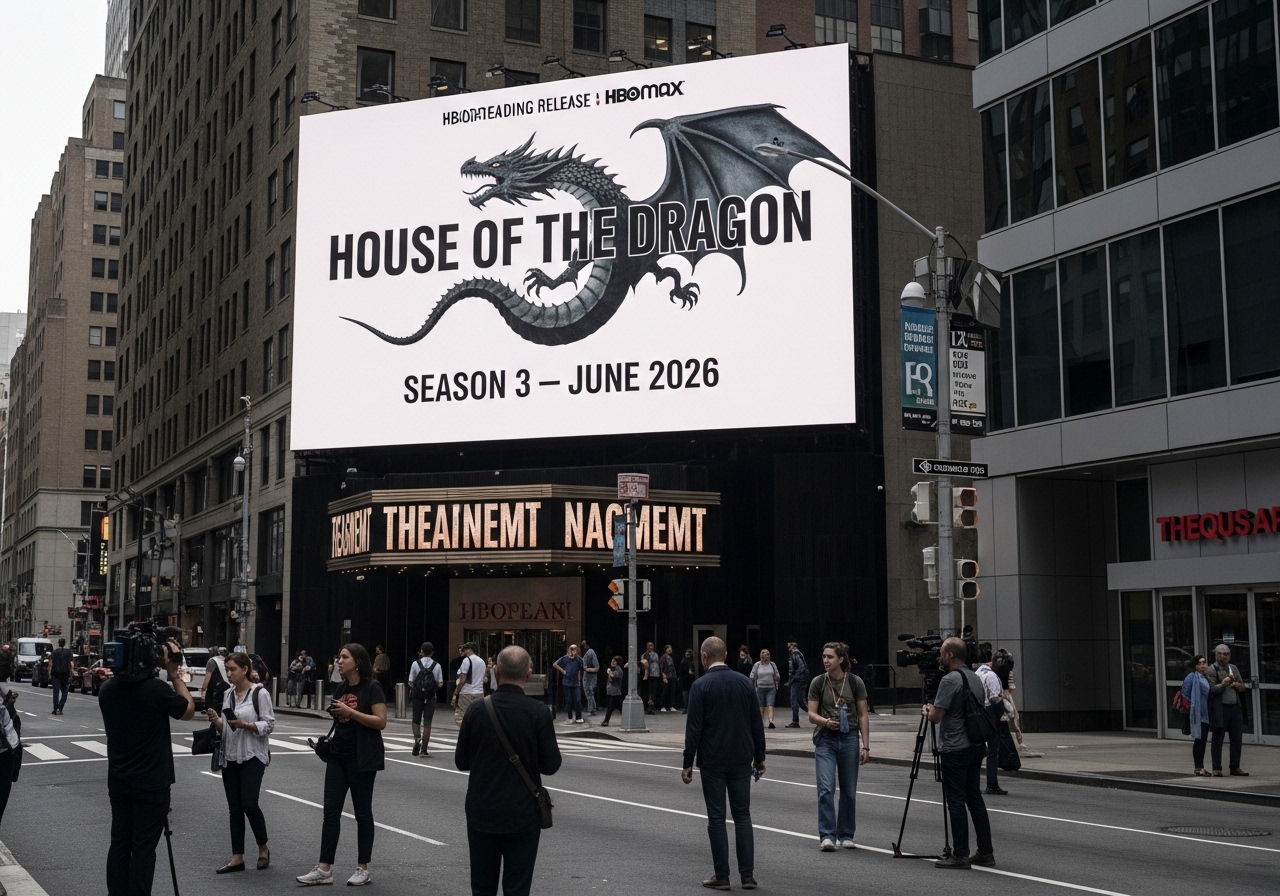
The fantasy drama is being positioned as one of HBO Max’s biggest summer releases, with its third season expected in June 2026 after the platform’s May slate clears the way for the return of Westeros.
NEW YORK — HBO’s summer programming calendar is beginning to revolve around a familiar source of fire and blood: House of the Dragon.
The third season of the Game of Thrones prequel is being discussed as one of the platform’s most important releases after May 2026, with HBO Max listing the series for a June 2026 return and entertainment outlets placing it among the biggest titles arriving once the platform moves beyond its May schedule. The timing gives Warner Bros. Discovery a powerful tentpole at the start of the summer streaming season, when major franchises often serve as both subscriber anchors and brand statements.
House of the Dragon remains one of HBO’s most valuable scripted properties. Set nearly two centuries before the events of Game of Thrones, the series follows the internal collapse of House Targaryen and the civil war known as the Dance of the Dragons. Its first two seasons established the rivalry between rival claimants and factions, turning dynastic succession into a story of family fracture, political miscalculation and escalating violence.
Season 3 is expected to carry that conflict into a more openly destructive phase. The second season ended with Westeros on the edge of wider war, leaving several armies, dragonriders and political players moving toward confrontation. For viewers, the promise of the new season is straightforward: after years of maneuvering, grief and betrayal, the Targaryen conflict is set to become more expansive and more dangerous.
That makes the show especially important for HBO after May. The platform’s May 2026 lineup includes original films, documentaries, returning unscripted series, licensed movies and live sports. But House of the Dragon belongs to a different category of programming. It is a premium scripted franchise with global recognition, a built-in audience and the ability to dominate weekly entertainment conversation across social media, entertainment press and international markets.
The series also arrives at a moment when streaming services are relying heavily on recognizable brands to hold audience attention. Fantasy, superhero, science fiction and franchise dramas have become central to the competitive strategies of major platforms, but few carry the same legacy as the Game of Thrones universe. Even after the divisive response to the final season of the original series, HBO has managed to keep Westeros commercially relevant through House of the Dragon.
The third season’s placement after May suggests a carefully staged programming handoff. May gives HBO Max a broad content slate, but June offers a chance to shift attention toward one of the company’s largest scripted investments. Weekly episodes can keep subscribers engaged over multiple weeks, generate recurring press coverage and create a sustained cultural footprint that single-day binge releases often struggle to match.
For HBO, that weekly model is part of the brand’s identity. Game of Thrones became a global phenomenon partly because each episode functioned as a shared event. House of the Dragon has followed that tradition, using Sunday-night appointment viewing to build anticipation, reaction and debate. In a streaming market increasingly defined by fragmentation, that kind of communal attention is rare and valuable.
The stakes for Season 3 are not only commercial. Creatively, the series is entering a phase that many readers of George R.R. Martin’s Fire & Blood regard as central to the Dance of the Dragons. The early seasons focused heavily on political positioning, inheritance disputes and the personal damage caused by delayed decisions. The next chapter is expected to test whether the show can balance spectacle with character-driven tragedy.
That balance has always been central to the Game of Thrones franchise. Dragons and battles may attract viewers, but the strongest moments in Westeros tend to emerge from choices made by damaged people under pressure. House of the Dragon has built its identity around that tension, presenting the Targaryens not as distant legends but as a ruling family devoured by entitlement, fear and grief.
Emma D’Arcy, Olivia Cooke, Matt Smith, Tom Glynn-Carney, Ewan Mitchell and other principal cast members have helped shape that conflict into a psychological drama as much as a political one. The central rivalry between Rhaenyra Targaryen and Alicent Hightower has evolved from friendship and misunderstanding into a rupture with consequences far beyond their own lives. Around them, advisers, children, soldiers and dragonriders have become trapped in a war machine that no single character fully controls.
The return of House of the Dragon also reinforces HBO’s broader commitment to the world created by Martin. The network has continued to develop Westeros-related programming, including A Knight of the Seven Kingdoms, while using House of the Dragon as the flagship continuation of its most famous fantasy universe. That strategy allows HBO to expand the brand without simply remaking Game of Thrones.
For Warner Bros. Discovery, the timing matters. The company has been under pressure to sharpen the identity of HBO Max in a crowded streaming market, where consumers frequently subscribe and cancel depending on major releases. A show such as House of the Dragon can reduce churn, attract returning subscribers and give the platform a high-profile centerpiece for marketing campaigns across television, digital platforms and international distribution.
The show’s production scale also makes it one of the clearest examples of what separates premium television from lower-cost streaming inventory. Large sets, elaborate costumes, visual effects, dragon sequences and battle staging require long planning cycles and significant investment. That expense is justified only if the series performs not merely as content, but as an event.
Season 3 will also face heightened expectations. The second season drew both praise and criticism, with supporters pointing to its performances and atmosphere while some viewers wanted faster movement toward large-scale war. That tension is likely to shape the response to the new season. If Season 3 delivers the scope implied by the story’s trajectory, it could re-energize the series and strengthen confidence in HBO’s long-term Westeros strategy.
There is also a practical reason entertainment outlets are highlighting House of the Dragon among post-May releases: June is a natural launch window for prestige genre television. Summer gives networks and streamers room to build campaigns around escapist programming while many traditional broadcast schedules slow down. For a fantasy drama with global reach, that timing can turn a season premiere into a major entertainment event.
The audience for House of the Dragon is not limited to fantasy fans. Like Game of Thrones before it, the show operates across genres: palace intrigue, family drama, war story, political thriller and tragedy. That breadth helps explain why the series remains a prominent part of HBO’s slate. It gives the platform a show that can appeal to viewers interested in spectacle while also serving audiences drawn to character conflict and moral ambiguity.
As May gives way to June, HBO Max will be looking for a title capable of commanding attention beyond routine platform updates. House of the Dragon Season 3 appears designed to do exactly that. Its return is not just another release on the calendar; it is a test of whether Westeros can continue to function as one of television’s defining fantasy franchises in a more competitive streaming era.
For now, the message from HBO’s schedule is clear. After May’s varied lineup of films, documentaries, unscripted programming and sports, the platform’s next major scripted event is expected to come with dragons. House of the Dragon Season 3 is positioned to carry HBO into summer with the kind of scale, familiarity and weekly momentum that streaming platforms increasingly need but rarely achieve.