The German chipmaker sees stronger growth as power components for artificial intelligence infrastructure surge and automotive orders begin to recover.
NEUBIBERG, Germany, May 6 — Infineon Technologies raised its full-year outlook on Wednesday, signaling that the artificial intelligence boom is spreading beyond the makers of processors and servers into the less visible but essential market for power semiconductors.
The German chipmaker, one of Europe’s most important semiconductor companies, said it now expects revenue in its 2026 fiscal year to rise significantly from a year earlier. Its previous forecast had called for only a moderate increase. The company also lifted its profitability target, saying its segment result margin should reach around 20 percent, compared with an earlier expectation in the high-teens range.
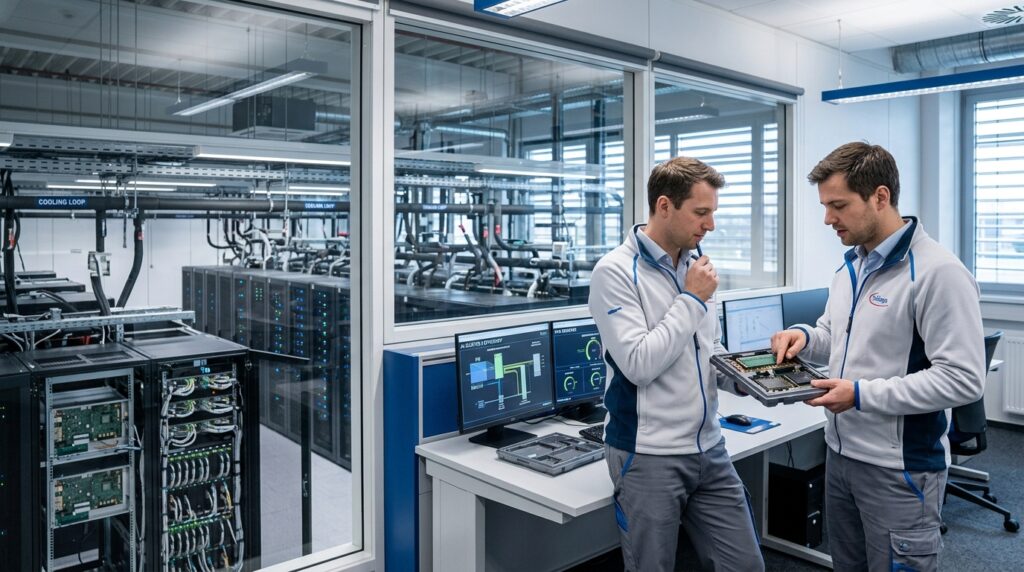
The upgrade reflects a faster-than-expected recovery in several end markets, but Infineon made clear that AI infrastructure is the main force changing the outlook. Data centers built for large-scale AI workloads require enormous amounts of electrical power, not only for computing chips but also for conversion, regulation, cooling and reliable distribution across server racks. Infineon supplies key components used in those systems, including power management and power conversion semiconductors.
“The AI boom strengthens further, and our power supply solutions for AI data centers are in very high demand,” Chief Executive Jochen Hanebeck said in the company’s earnings statement. He added that power infrastructure was gaining momentum and becoming a more important growth driver for Infineon’s industrial business.
Infineon said it expects revenue of around 1.5 billion euros from AI data center applications in fiscal 2026, with that figure rising to about 2.5 billion euros in fiscal 2027. The estimate underlines how quickly AI has become a material business for a company historically associated with automotive chips, industrial power electronics and embedded security.
For the second quarter of fiscal 2026, which ended March 31, Infineon reported revenue of 3.812 billion euros, up from 3.662 billion euros in the previous quarter. Segment result was 653 million euros, broadly stable from 655 million euros in the first quarter, while the segment result margin stood at 17.1 percent. The company forecast third-quarter revenue of about 4.1 billion euros, based on an assumed euro-dollar exchange rate of 1.17.
The revised full-year outlook also includes a higher cash-flow forecast. Infineon now expects adjusted free cash flow of around 1.65 billion euros, up from a previous estimate of about 1.4 billion euros. Free cash flow is expected to reach roughly 1.25 billion euros, compared with the earlier forecast of about 1 billion euros.
The results show how AI investment is reshaping the semiconductor supply chain. Nvidia and other makers of advanced processors have captured most of the attention, but the power demands of AI data centers have created opportunities for companies that produce less glamorous but equally critical components. Every AI server needs systems that convert electricity efficiently and keep voltage stable under heavy workloads. As data centers become denser and more energy-intensive, power semiconductors move closer to the center of the growth story.
Infineon’s Power & Sensor Systems division was a major beneficiary. Revenue in the segment rose to 1.260 billion euros in the second quarter from 1.171 billion euros in the previous quarter, driven by continued strong demand for servers and AI data centers, as well as rising demand for automotive radar sensors, mobile devices and power semiconductor applications. The segment result margin improved to 20.4 percent from 17.4 percent.
The company’s Green Industrial Power division also improved, with revenue rising 15 percent sequentially to 403 million euros. Infineon said the increase was driven by stronger demand across power infrastructure, heating, ventilation and air conditioning systems, and home appliances. That performance adds to the view that the AI cycle is widening into electrical infrastructure and industrial systems, not simply lifting chipmakers directly tied to graphics processors.
Automotive, Infineon’s largest business, remained mixed but showed signs of stabilization. Revenue in the Automotive division edged up to 1.830 billion euros from 1.821 billion euros in the previous quarter. The segment result margin fell to 18.1 percent from 22.1 percent, reflecting weaker revenue in high-voltage components for electric vehicles, restructuring costs and normal price reductions at the start of the year.
Even so, Infineon said automotive order intake had improved and pointed to positive developments in software-defined vehicles, a category that uses more computing, sensors, microcontrollers and power management components. Hanebeck said market share gains in automotive confirmed that the company was “overall on the right track,” while acknowledging continuing pressure in the high-voltage e-mobility business.
That split captures the broader state of the chip industry in 2026. AI infrastructure is expanding rapidly, while automotive and industrial demand are recovering more unevenly after a long period of inventory correction and weaker end demand. Carmakers are still navigating slower electric-vehicle growth in some markets, pricing pressure and changes in production plans. At the same time, vehicles are becoming more software-driven and more semiconductor-intensive, supporting longer-term demand for companies such as Infineon.
Infineon’s outlook is also notable because it comes from a European manufacturer with deep roots in power electronics rather than from a Silicon Valley AI chip designer. The company is headquartered in Neubiberg, near Munich, and had around 57,000 employees worldwide at the end of September 2025. It generated about 14.7 billion euros in revenue in fiscal 2025.
The company’s role in the AI supply chain is closely tied to energy efficiency. Power semiconductors help reduce energy losses as electricity moves through data center equipment. In large AI installations, even small improvements in conversion efficiency can matter because the total power load is so high. That gives companies with expertise in silicon, silicon carbide and gallium nitride technologies a larger strategic role as operators seek to control electricity costs and reduce pressure on grids.
Infineon is also streamlining its organization. From the fourth quarter of fiscal 2026, the company will reduce its business segments from four to three: Automotive, Power Systems and Edge Systems. Management said the new structure is intended to clarify ownership of focus applications, speed up decisions and bring system solutions to customers faster.
The restructuring reflects a market in which customers increasingly want complete systems rather than individual components. In AI data centers, for example, chipmakers must understand power supply units, server racks, battery backup systems and grid interfaces. In vehicles, they must serve platforms built around software, connectivity, sensors and electric drivetrains. Infineon is trying to align its internal structure with those application areas.
The company remained cautious about risks. Hanebeck said Infineon was entering the second half of the fiscal year with confidence but would continue to monitor geopolitical and macroeconomic developments. The semiconductor industry is still exposed to trade tensions, currency movements, export restrictions, fluctuating capital spending and the timing of customer inventory cycles.
For now, however, Infineon’s message is more optimistic than it was earlier in the fiscal year. The company says it fully achieved its targets in the first half and expects stronger growth in the second half. The improved guidance suggests that demand from AI data centers is not only offsetting weakness in parts of the electric-vehicle market but also creating a broader upturn across power infrastructure.
The announcement places Infineon among a growing group of chip companies benefiting from AI infrastructure spending. But its position is distinct. Rather than selling the processors that train and run AI models, Infineon sells the components that help deliver the electricity those processors require. As the AI build-out accelerates, that supporting role is becoming a larger and more profitable business.”””