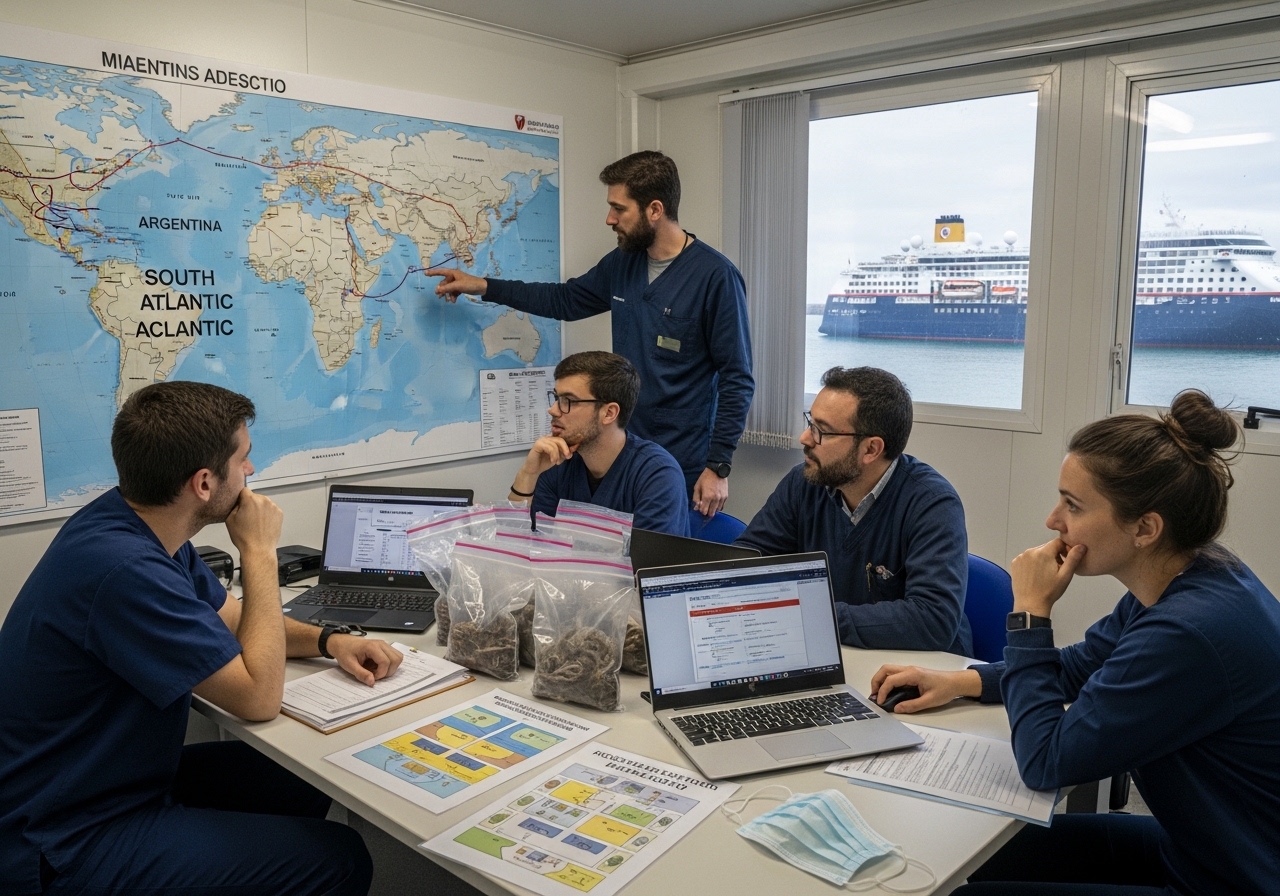
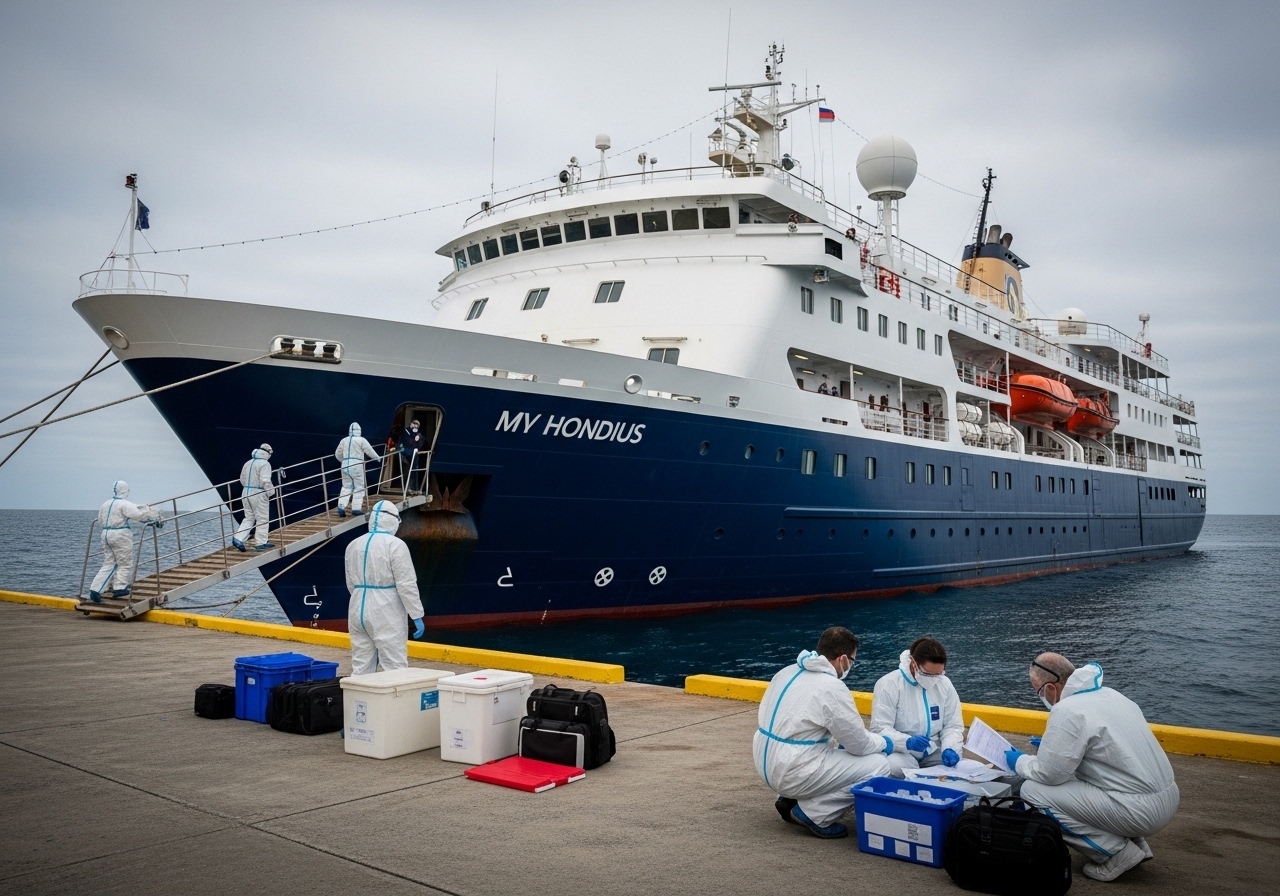
The deadly cluster aboard the MV Hondius has focused attention on rodent exposure, rare Andes virus transmission and the challenges of managing serious illness in the confined environment of a vessel at sea.
CAPE TOWN — Scientists and public health officials are investigating how hantavirus, a rare and sometimes fatal infection usually linked to rodents on land, appeared among passengers and crew aboard the expedition cruise ship MV Hondius, raising urgent questions about whether the virus was brought on board after exposure in South America or spread between people in the ship’s close quarters.
The Dutch-flagged vessel, operated by Oceanwide Expeditions, has been at the center of an unusual maritime health emergency after three people died and several others fell ill during or after a voyage that began in Argentina and crossed the South Atlantic. Health authorities have confirmed hantavirus infection in some patients, while other cases remain under investigation. The World Health Organization and national agencies are coordinating medical evacuations, testing, isolation procedures and plans for a full inspection and disinfection of the ship.
The incident is unusual because hantavirus is not normally associated with cruise ships. It is best known as a zoonotic infection, meaning it passes from animals to humans, usually when people inhale dust contaminated with urine, droppings or saliva from infected rodents. In the Americas, some hantaviruses can cause hantavirus pulmonary syndrome, a severe respiratory illness that may progress rapidly and requires intensive supportive care. There is no widely available specific cure for the disease.
The central scientific question is where the exposure occurred. One possibility is that infected rodents or contaminated material were present on the ship, allowing viral particles to become airborne in enclosed spaces such as storage areas, utility rooms or cabins. Ships have long been vulnerable to rodent problems because food supplies, cargo and sheltered compartments can attract rats and mice. Even modern vessels with strict sanitation systems can face inspection challenges when contamination occurs in hidden or hard-to-reach spaces.
Another possibility is that the original exposure happened before boarding, during travel or excursions in Argentina, where Andes virus, a South American hantavirus strain, is known to circulate. The MV Hondius had been operating a polar and South Atlantic itinerary, a type of expedition voyage that often involves remote landings, wildlife observation and visits to environments where passengers may come into contact with soil, vegetation, animal habitats or old structures. If one or more travelers were infected before embarkation, symptoms could have emerged days or weeks later while the ship was already far from major medical facilities.
That timeline matters because hantavirus illness does not usually appear immediately after exposure. The incubation period can extend for weeks, making it difficult for investigators to identify a single location, activity or contact that explains all the cases. Epidemiologists will examine travel histories, cabin assignments, dining records, shore excursions, medical logs and contact patterns among passengers and crew. They will also look for signs of rodent activity on board and may test environmental samples from cabins, ventilation areas, stores and waste-handling spaces.
A third and more concerning possibility is limited human-to-human transmission. Most hantaviruses do not spread efficiently between people. But Andes virus is the major exception cited by scientists, with past outbreaks in Argentina and Chile raising evidence of transmission among close contacts, especially household members, caregivers or people with prolonged face-to-face exposure. Health officials have said the MV Hondius cases may involve that strain, and the pattern of illness among close contacts is one reason investigators are not ruling out person-to-person spread.
That does not mean hantavirus behaves like influenza, COVID-19 or norovirus on ships. Those infections can spread rapidly through respiratory droplets, contaminated surfaces or shared spaces. Hantavirus transmission between humans, when it occurs, appears much more limited and usually requires close contact. That distinction is crucial for assessing wider risk. Public health officials have emphasized that the general public is not believed to face a high risk from the cruise ship cluster, even as the cases on board are treated as a serious emergency.
The confined nature of a ship, however, complicates containment. Passengers and crew share corridors, dining spaces, medical facilities, air systems and emergency procedures. Sick travelers may need evacuation by air or transfer to countries with intensive-care capacity. Others may require monitoring for fever, respiratory symptoms and oxygen levels. Isolation on board can reduce contact but cannot fully replicate hospital infection-control conditions, especially when a ship is waiting for permission to dock.
The MV Hondius case also illustrates the difficulty of responding to a rare disease far from the place where it is most commonly acquired. A cruise vessel moving between jurisdictions can involve multiple governments, port authorities, health ministries and international organizations. Patients may be evacuated to different countries, samples may be tested in separate laboratories and passengers may hold passports from many nations. That creates a complex chain of reporting, risk communication and repatriation.
Investigators will also study whether the ship’s route and timing match the known ecology of Andes virus. Infected rodents shed virus without appearing sick, and human infections can occur when people disturb contaminated dust in cabins, barns, sheds, campsites or rural buildings. Expedition travelers may pass through remote environments where rodent control is less predictable than in cities. Even a brief exposure can be difficult to reconstruct after a long voyage.
For passengers still on board or recently disembarked, the practical concern is monitoring. Early symptoms can resemble flu or other viral illnesses, including fever, muscle aches, headache, nausea, vomiting and fatigue. Severe cases can progress to coughing, shortness of breath and fluid buildup in the lungs. Because early signs are nonspecific, doctors rely heavily on exposure history, laboratory testing and rapid escalation of care when breathing problems develop.
The deaths have sharpened public attention because hantavirus infections are rare but can be severe. In many years, the disease receives little public notice outside affected regions. It tends to become visible only when a cluster occurs, a fatal case is reported, or an infection appears in an unexpected setting. A cruise ship outbreak is especially striking because maritime outbreaks are more often associated with gastrointestinal viruses or respiratory infections that spread easily among large groups.
The response now depends on separating what is known from what is suspected. Known facts include a serious cluster of illness and death linked to the MV Hondius, confirmed hantavirus infection in some patients, and international coordination to treat patients and investigate the vessel. Still uncertain are the original source, the exact transmission chain, the role of any rodents or contaminated materials on board, and whether person-to-person spread occurred after embarkation.
The outcome of the investigation could have consequences for expedition cruising. Operators may face closer scrutiny of rodent-control systems, pre-boarding health questionnaires, excursion risk assessments, medical preparedness and protocols for rare zoonotic diseases. Expedition ships often travel to remote places precisely because passengers seek wildlife, isolation and unusual landscapes. Those same qualities can complicate medical evacuation and disease investigation.
For the broader public, scientists are likely to stress perspective. Hantavirus is dangerous but uncommon. It is not normally a cruise-associated disease, and it does not usually spread casually from one passenger to another. The main prevention message remains avoiding contact with rodent droppings, urine, nesting material and contaminated dust, especially in places where the virus is known to circulate. Cleaning suspected rodent contamination requires wet disinfection methods rather than sweeping or vacuuming, which can aerosolize particles.
The MV Hondius investigation is therefore not only about one ship. It is a test of how global health systems manage rare zoonotic threats in highly mobile environments. It brings together rodent ecology, travel medicine, maritime law, laboratory diagnostics and the psychology of passengers confined at sea after deaths on board.
Until investigators complete their work, the most likely explanation may remain a combination of factors: exposure linked to an endemic region, delayed symptom onset during travel and possible close-contact transmission among a small number of people. What scientists must now determine is whether the virus came aboard in the environment, in an already infected traveler, or through a chain that included both.
The answer will matter for the passengers and crew of the MV Hondius, but also for future outbreak planning. A rare virus appearing on a ship is a reminder that the boundary between remote landscapes and global travel is thin. When people move quickly across continents and oceans, pathogens that usually belong to specific places can appear in unexpected settings — and force scientists to reconstruct, step by step, how they got there.